William Crookes Quotes
England and all civilized nations stand in deadly peril of not having enough to eat. As mouths multiply, food resources dwindle. Land is a limited quantity, and the land that will grow wheat is absolutely dependent on difficult and capricious natural phenomena... I hope to point a way out of the colossal dilemma. It is the chemist who must come to the rescue of the threatened communities. It is through the laboratory that starvation may ultimately be turned into plenty... The fixation of atmospheric nitrogen is one of the great discoveries, awaiting the genius of chemists.
William Crookes, 1832-1919, English Physicist, Chemist & President, British Association for the Advancement of Science, Presidential Address to the British Association for the Advancement of Science, 1898
Sourced by: Eigen's Political and Historical Quotations

Britain, in order to protect the landed gentry and aristocracy who made their money via agriculture, long had the Corn Laws (Corn was the term for wheat.) which was a protectionist system making it virtually to import food grains, rice or potatoes into Britain. However, with the growth of the population and a protected agricultural industry that had no drive to be more productive there was not quite enough food in the kingdom. When there was a potato blight in Ireland, the situation reached critical proportions. Victoria was not generally in favor of protectionism, and given the shortage and high cost of food then, she wanted to allow food imports. Robert Peel presided over a government where the protectionists who represented the large landowners had a very strong block. Pushing for an end to the Corn Laws could have caused the government to collapse. Peel himself did not think the Corn Laws were good policy and created a hardship for most people especially the poor. But he was the leader of his party and the party was split on the Corn Law issue. Victoria, in this private letter, tells him to do what he things is right and not what is politically expedient. Peel tried but at this time could not get a majority to repeal the Corn Laws, and the Irish Potato Famine killed millions. See {630738} . Peel however stuck with the Queen’s and his perception of what was right. The following year he proposed the Importation Act 1846 which repealed the Corn Laws. Many of his own party would not support it, but this time, he went to the two opposition parties and created a slim majority which passed the bill much to the approval of the Queen.


Often referred to as “Father of the Green Revolution” for his contributions to food growing throughout the world

The Depression had 25% unemployment and many people lacked even food to eat. Meanwhile, there was a huge amount of unused, idle land in California.

“Sir Robert” was Prime Minister Robert Peel. See {630737}.

From a technical and production point of view, there is no practical limit to population size that is imposed by food production. We can produce sufficient food for the world even if population increases dramatically. None the less, even today we have some starvation and much malnutrition problems. These however are political, economic and tend to be distributional. We can produce the food. Morris does NOT advocate large population growth. Although food need not be a problem with an expanding population, job availability, medical care, energy, land, natural resources, ethnic hatred, migration, violence, and other problems are produced by population growth.


The “inputs” her refers to are fertilizer, water, pesticides, equipment, transportation and energy for these. See {631857} for another way of phrasing this.
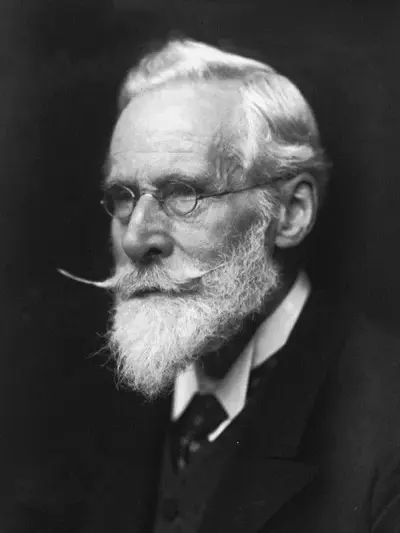
Sir William Crookes OM PRS was a British chemist and physicist who attended the Royal College of Chemistry in London, and worked on spectroscopy. He was a pioneer of vacuum tubes, inventing the Crookes tube which was made in 1875. This was a foundational discovery that eventually changed the whole of chemistry and physics.
