Hesiod Quotes
Do not gain basely; base gain is equal to ruin.
Hesiod. Works and Days. Translated by Hugh G. Evelyn-White, Harvard University Press, 1914, line 352.


Marcus Porcius Cato Uticensis


1st Earl of Beaconsfield

Originally it was published in Boston under the name “A Columbian Patriot.”

He and the other commissioners of both political parties were agreed that the procurement by The State Department, USAID, and especially the Defense Department which spent the most was terrible. The even had military generals in charge of billions of dollars of procurement who did not even know the procurement laws and regulations they were supposed to obey much less the skill of good procurement.


Clark, after becoming one of the richest men in America, wanted to go into National Politics, but most people hated him so he could never win elected office. At the time, Montana selected their Senators by a vote of the State Legislature. So Clark bribed enough members of the legislature to become the Senator. However, the bribery scheme became a public scandal and the Senate refused to seat him. So the legislature had another vote in the next legislative session and Clark won again, and that time no one had the evidence of the bribes. But then, more about Clark became known, and he just served the one term.

In 1811 Calhoun was a freshman congressman. Congress was considering raising 10,000 men to resist the encroachments of Great Britain. The large cost of the enterprise was preventing the measure from passing. Calhoun objected to considering the cost factor at all:

Africa and the Middle East, and the former Soviet States were particularly plagued with this problem, but is was also common in Asia and Latin America.

He was Governor-General of Korea when he made this statement. “Squeeze” was the word for bribes literally translated then from Korean. In most instances of racial discrimination “laziness” is almost always attributed to the so called “inferior” people, like the British with the Arabs, and the American Southerners with the Negroes.


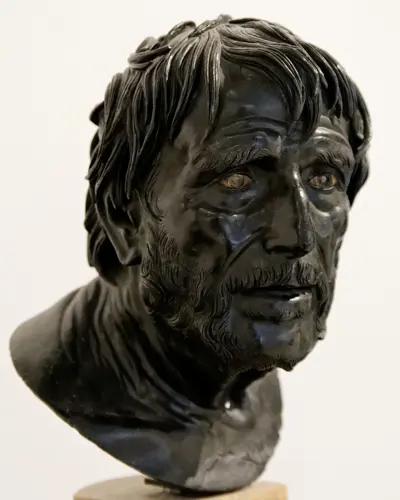
Hesiod (/ˈhiːsiəd, ˈhɛsiəd/; Greek: Ἡσίοδος Hēsíodos, 'he who emits the voice') was an ancient Greek poet generally thought to have been active between 750 and 650 BC, around the same time as Homer. He is generally regarded as the first written poet in the Western tradition to regard himself as an individual persona with an active role to play in his subject. Ancient authors credited Hesiod and Homer with establishing Greek religious customs. Modern scholars refer to him as a major source on Greek mythology, farming techniques, early economic thought, archaic Greek astronomy and ancient time-keeping.
