Elie Metchnikoff Quotes
Disease is not the prerogative of man and the domestic animals, so it was quite natural to see if the lower animals, with very simple organizations, showed pathological phenomena, and if so, infection, cure and immunity could be observed among them.
Metchnikoff, Élie. "On the Present State of the Question of Immunity in Infectious Diseases." Nobel Lecture, 11 Dec. 1908, Nobel Foundation.


The South has always been backward compared to the rest of the nation. By the 21st century the gap had gotten narrower. However, one of the reasons that Mrs. Roosevelt was unpopular with the Southern whites was not only that she was an outspoken critic of segregation and associated with Negroes, but she would publically point out the areas of Southern backwardness. However, the upper and middle class Southerners resented anyone—especially “outsiders” publicly exposing Southern weakness.


The white Europeans had over centuries built up immunity to some of the worst infectious diseases but when they first landed in the New World brought smallpox and other deadly diseases to which the Indians had no immunity.

The graphic is a painting of the effect of the plague in Ireland. Clearly his first sentence exaggerates, but there were some areas where most humans died. See {620882} for a Muslim Historian’s description of the plague.


No one at the time knew the answer to the question but we do today. The colonial whites brought small pox with them to the new world. The whites had many generations of building immunity to small pox so that only a small percentage of whites who contracted the disease would die. The Indians, however, had never before been in contact with small pox and their immune. Their systems had not had the time to evolve resistance to the disease. The same thing occurred with the Spanish conquistadors and the native people in Central and South America only the percentage of death was much higher than the Indians of North America—possibly due to more sexual and other interpersonal contact, possibly climate, and possibly the North American Indians were better nourished and generally healthier to better withstand the disease which wiped out the vast majority of the Indians of Central and South America.
The graphic is the famous Benjamin West painting of the treaty signing between the Lenape Indians and William Penn in 1686. Tenoughan was one of the Indians depicted at the signing but we do not know which one.

This is an amazing quotation and shows that the Ancient Romans who had a very sophisticated medical technology had a notion of germs and microbes. Ancient Rome was the first organized nation for which health, medicine, public health, and medical research were governmental functions unlike Greece and other civilizations where health was a personal function. Roman policy emphasized prevention unlike the Greeks. Sanitation and water supply and quality were government responsibilities and the Roman standard was not reached in the rest of the world until the 18th century. Heath and medicine was also a major military responsibility. The Roman Empire depended on its army, and trained professional soldiers. Disease was a greater risk to the soldiers than were battlefield casualties, and the Romans had a strong vested interest in keeping these highly trained men alive and healthy—not just the wealthy Roman citizens. The Romans were open to techniques that were developed throughout the Empire and beyond and tended to adopt all good ideas and a few bad ones as well While they had advanced surgery, the public health was the strongest aspect of Roman medicine and health and this notion of germs and disease. Remember that the writer was not a medical or scientific man, but was just indicating what was general wisdom of the Roman elite.

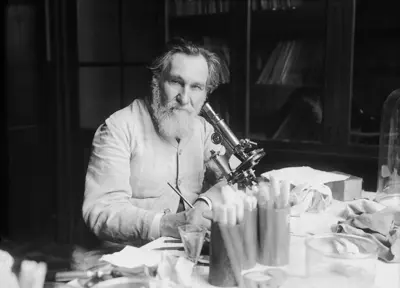
Ilya Ilyich Mechnikov was a Russian Imperial zoologist of Moldavian and Ukrainian Jewish origin best known for his pioneering research in immunology.
