William Blake Quotes
Dip him in the river who loves water.
Blake, William. The Marriage of Heaven and Hell. 1790. The Complete Poetry and Prose of William Blake, edited by David V. Erdman, Anchor Books, 1988, p. 36.


This unfortunate concept is in the literal Biblical history of Judaism and Christianity as well as Islam.

While some of the Serbian holidays commemorate loss of battles, the idea of a specific Day of Revenge is new.
This proverb only makes sense in the light of understanding the Arab concept of revenge—“blood.” In a rural desert environment where little can be expected of government, the Arabs have developed a law enforcement and peace keeping mechanism which while primitive from modern standards, nevertheless worked to some degree. It is that revenge—“blood” is a moral necessity and obligation of all people, and revenge is not limited by time or to the individuals involved in the first incidence. The immediate family are the first to exact revenge, but the extended family follows and often the entire clan. Sometimes revenge is tribal or even national. Anyone who fails to revenge a member in his group is not only a disgrace, but is a clear and present danger to the group because then they can be attacked with impunity. So revenge is a strong obligation of the group members and blood must be paid with blood no matter how many generations it may take. The only thing that keeps me and my family safe, is the surety what whosoever kills one of us will themselves be killed or if they die a natural death we will take revenge on one of the evildoers relatives and no one is exempt. Crime must never pay!


Johnson was Vice President at the time. What he did not realize at the time was that one of the plotters was supposed to have killed him at the same time as the others, but the assassin got cold feet at the last minute and never entered Johnson’s house.

This sura on retaliation for murder is behind the Saudi Arabian law which allows the male relative of a murder victim to personally wield the sword in the beheading of the murderer.


An American ambassador and 3 staff had been killed in a terrorist attack on our Consulate in Bengasi, Libya. The CIA and the rest of the American intelligence had initially analyzed the event and gave a report to the Administration “explaining” the event. American officials who did not see the incorrect intelligence report, hypotheses that it was a planned terrorist attack which it appeared to be from the news reports read by amateurs, However, the United Nations Ambassador was given the incorrect report and was asked by the White House to appear on the News Shows, reveal the contents of the report and state that this was a preliminary analysis and subject to change upon further data and analysis. She did that, but many journalists and politicians thought that her version did not comport with the facts. Soon it was discovered that the initial Intelligence report was all wrong and not even close to the truth and the people who guessed from the press reports had gotten it right. Graham and other members of Congress were very angry. So Graham made a public announcement stating the U. N. Ambassador was unfit for a senior job as she either lied to the country of was too naïve to see the truth which so many others had seen. There were dozens of people who might have either made a mistake or were otherwise responsible for the erroneous report which in hindsight appeared very flawed. At the top of the list was the CIA Director who had been America’s best heroic and victorious general who had recently taken the post and was very popular. So Graham and some of his fellow members of Congress called for the head of the one person involved and at a high level who had NOTHING to do with preparing and approving the wrong and misleading intelligence report and did not cast blame on any of the people who made the error or approved it. The quotation is typical of members if Congress who, insist on having the public stage before they know most of the facts, have little idea of how to manage anything, pick the easiest target to attack without worrying top much about the real culprits if any, and the lack of courage enough to blame a very powerful figure who if he did not personally err, the problem occurred on his watch. See {625924} for a view of the courage of Congressmen. Graham was actually a much better than average Senator, at the time but Congress had a 90% disapproval rating with the citizens.

Cromwell’s army of Parliament massacred all the town’s defender. Cromwell had issued an ultimatum to the town commander which had been refused. See {632367}.

Earlier, his father had also castigated the ministers over their inept hard-line handling of the American Revolution. See {641505} .

This was one of Jackson’s official major justifications for his controversial Indian Removal policy. The logic was that since there had been some Indian raids on whites with whites being killed, the whites had a right to retaliate and a good way of doing that was by taking their land and removing them to lands far away. He saw a Christian virtue to the policy as they whites did not raid and kill the Indians. The “logic” such as it was, of course, ignored the fact that there had been white raids and massacres of Indians as well, but in both cases, they were done by a small minority of the Indians and Whites, Jackson’s view was that all Indians should be held responsible for the act of some violent Native Americans. However Jackson had used this guilt generalization before and even used the term “retaliatory vengeance” when he vowed revenge on the British for his treatment as a Prisoner of War in the American Revolution — See Quotation 621975.


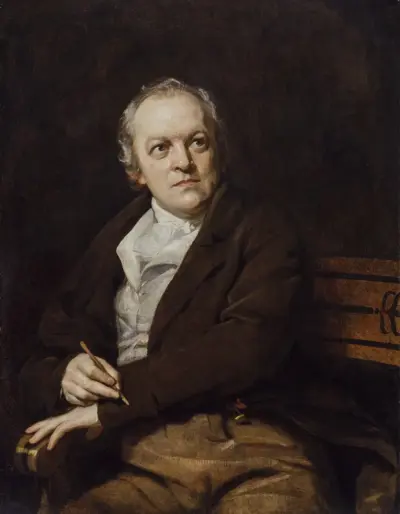
William Blake was an English poet, painter, and printmaker. Largely unrecognised during his lifetime, Blake is now considered a seminal figure in the history of the poetry and visual arts of the Romantic Age. What he called his prophetic works were said by 20th-century critic Northrop Frye to form "what is in proportion to its merits the least read body of poetry in the English language". His visual artistry led 21st-century critic Jonathan Jones to proclaim him "far and away the greatest artist Britain has ever produced". In 2002, Blake was placed at number 38 in the BBC's poll of the 100 Greatest Britons. While he lived in London his entire life, except for three years spent in Felpham, he produced a diverse and symbolically rich œuvre, which embraced the imagination as "the body of God" or "human existence itself".
