Steve Forbes Quotes
Credit default swaps were nothing more than souped up versions of things that have been around for a long time like soy bean futures
It was the souped up nature of the credit default swaps that was in part responsible for the souped up melt down of the economy of 2008 and the great recession thereafter. A credit default swap is an insurance policy that a company will pay off its bonds and not go bankrupt. It is a cross between an insurance mechanism and a stock exchange type security mechanism and through heavy lobbying escaped any kind of regulation. It cost a company no money to write a credit default swap and they were paid to do so. As long as business and the economy was good, it was a terrific business but there was no way of ever knowing how much risk they were taking. So companies who wrote credit default swaps did not have to have the money to pay to back them up if they business was bad. When that happened in 2008 even the largest insurance company in the world collapsed because of the risk of having to pay the credit default swap and the U. S. Government had to take over the insurance company. In 2010, the Obama administration passed a financial reform bill that began to regulate credit default swaps.
Malcolm S. [Steve] Forbes, Jr., Publisher Forbes Magazine, Candidate for Republican Presidential Nominee, Speech, National Libertarian Convention, Las Vegas, August 8, 2010
Sourced by: Eigen's Political and Historical Quotations


Despite this warning, and the hundreds of billions of dollars of people’s money that was lost on derivatives, and recommendations for not allowing derivatives to bought or sold by institutions who invest the public’s money, derivatives were not outlawed by Congress in its efforts to reregulate the financial industry.


Credit default swaps were in large part responsible for the melt down of the economy of 2008 and the Great Recession thereafter. A credit default swap was one of the favorite derivatives that became popular. Is an insurance policy that a company will pay off its bonds and not go bankrupt. It is a cross between an insurance mechanism and a stock exchange type security mechanism, and through heavy lobbying, escaped any kind of regulation. It cost a company no money to write a credit default swap, and they were paid to do so. As long as business and the economy was good, it was a terrific business but there was no way of ever knowing how much risk they were taking. So companies who wrote credit default swaps did not have to have the money to pay to back them up. When that happened in 2008, even the largest insurance company in the world collapsed because of the risk of having to pay the credit default swap and the U. S. Government had to take over the insurance company. In 2010, the Obama administration passed a financial reform bill that began to regulate credit default swaps. Buffet, the American who had made the most money in financial securities, realized the great danger not only to the company, but to the entire national economy. Most of the rest of the financial institutions, could make large amounts of money without have to have much capital as long as things went well. So credit default swaps began to exceed the other financial instruments in activity. Neither the Federal Reserve or the other government regulatory agencies chose to regulate these risky instruments nor even to require that they be publicly disclosed -- See {637987}, {637986} and {637992}.


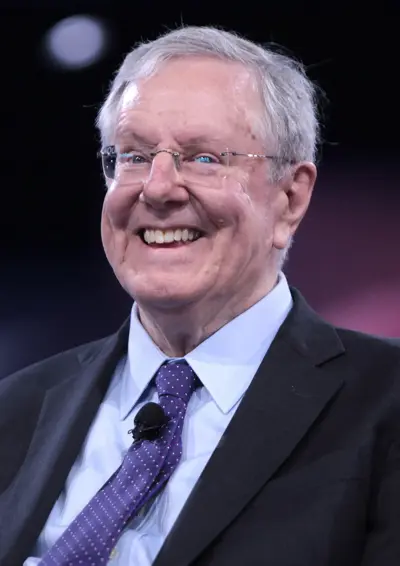
Malcolm Stevenson "Steve" Forbes Jr. is an American publishing executive and politician. Forbes was a candidate in the 1996 and 2000 Republican presidential primaries. Forbes is the Editor-in-Chief of Forbes, a business magazine. Forbes is the son of longtime Forbes publisher Malcolm Forbes, and the grandson of that publication's founder, B.C. Forbes. He is an adviser at the Forbes School of Business & Technology.
