George F. Will Quotes
Creative semantics is the key to contemporary government; it consists of talking in strange tongues lest the public learn the inevitable inconveniently early.
Will, George F. The Pursuit of Happiness, and Other Sobering Thoughts. Harper & Row, 1978, p. 110.


See {583419} for more on this technique.

The George W. Bush administration became notorious for its deception of Congress, the Press and the public. In particular, the administration would develop elaborate scenarios of conditions in the world and develop military and foreign policy responses to them. Soon, it became clear that the scenario upon which the policy and action had been based, was inaccurate—a fantasy to begin with. There has been much debate whether the scenarios were deliberate lies to drum up political support for the administration or just errors of judgment based on bad intelligence. Snow, had to go out and maintain the scenarios even after it became clear that they had been fantasies.


If a government can classify embarrassing information, then it does not have to lie which is why over-classification is so prevalent. But then the officials have to lie in the classification process by claiming national security is involved as opposed to their own or their party’s security from embarrassment. Most officials prefer to tell the truth and not deceive the public. However, a large proportion have their moral instincts compromised by confusing the national interest with the politicians’ interest

In 1956 Secretary of State, John Foster Dulles, testified before the Senate Foreign Relations Committee. The chairman was unhappy with his testimony:

Alsop, a political hawk was convinced, as many other right wingers were at the time that the Russians had forged ahead of us in offensive missiles. When he asked President Eisenhower, the President never denied it, but never went to Congress to ask for more money to close the “missile gap”. Alsop made this shocking accusation which offended many Americans, but pleased the ultra-hawks and anti-communists. Most of the nation however then believed that there was a missile gap, with varying explanations of Eisenhower’s silence on the matter. Two years later John F. Kennedy, used the “missile gap” when running in 1960 against Nixon by attacking Nixon and Eisenhower for allowing us to fall behind the Russians at have a missile gap. When Kennedy became President, he was very surprised that there was no missile gap favoring the Russians—it was favoring the United States. Eisenhower did not want the Russians to know that he knew exactly what they were producing and deploying in missiles through great espionage sources. By not saying anything in the face of the accusations, the Russians assumed that the Americans really thought that they had more capacity than they did. And Eisenhower wanted that so that they would be secure that the United States had no real knowledge of their missile capacity. If Eisenhower had actually told the nation that the Russians were really behind us, the Russians would suspect a security leak and our sources could be compromised.


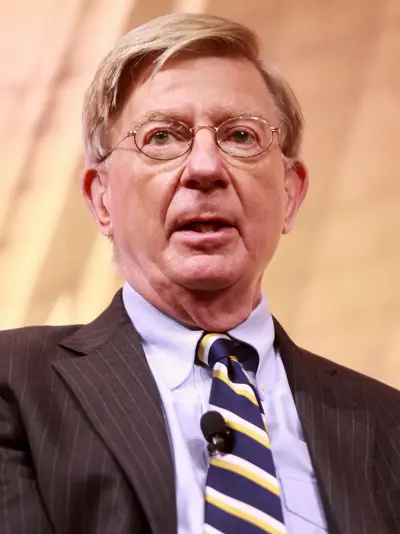
George Frederick Will is an American libertarian-conservative political commentator and author. He writes regular columns for The Washington Post and provides commentary for NBC News and MSNBC. In 1986, The Wall Street Journal called him "perhaps the most powerful journalist in America," in a league with Walter Lippmann (1889–1974). He won the Pulitzer Prize for Commentary in 1977.
