Paul Samuelson Quotes
Contrary to what many skeptics had earlier believed, the Soviet economy is proof that a socialist command economy can function and even thrive.
Samuelson, Paul A., and William D. Nordhaus. Economics. 13th ed., McGraw-Hill, 1989, p. 837.


This quotation illustrates White’s favorable view of Russia. Note his use of the “it works” phrase which he picked up from Stefens’ famous quote {634892}. At the time the Soviet Union had been perceived by many economists to have been a great economic improvement over Czarist Russia. And over all, Russia which in 1917 was an economic basket case, had become one of the stronger states in Europe although the Russian people paid a horrendous price. Most historians agree that White passed classified information to the Russians. He was accused of being a Communist, but there was never any evidence of that. Some people believe that he was a spy for the Russians and committed espionage, but others disagree observing that White was very much his own man and felt that much information that was classified never should have been. White substituted his own judgment, it is believed, about what could be given to the Russians for the security system. He was an admirer of what Russian socialism had accomplished economically, educationally and medically since the 1917 revolution deposing the Czar. Russia had been a valuable military ally, which had taken the brunt of both military and civilian casualties in WWII. White’s economics were certainly not Marxist but very much Keynesian. He was subpoenaed by the House Un-American Activities Committee where he was accused of being a Communist which he denied (see {634907}). He died of a heart attack 3 days later.

At the time extreme socialist doctrine was that the state should own the factories and the other means of industrial production. The socialists believed that the people through their government had to be able to control the economy and the private owners’ greed would always drive the economy for themselves and not for the society in general. Deal was one of the first who argued that there were other, less draconian modes of economic control like government regulation and central banks. Deat turned traitor during WWII and served in the Vichy Nazi cabinet of Pierre Laval. He was sentenced to death for treason but escaped to Italy where he assumed a new identity and then was sheltered by a right-wing Catholic religious order in the convent of San Vito, near Turin, where he wrote his memoirs and lived undiscovered until his death.


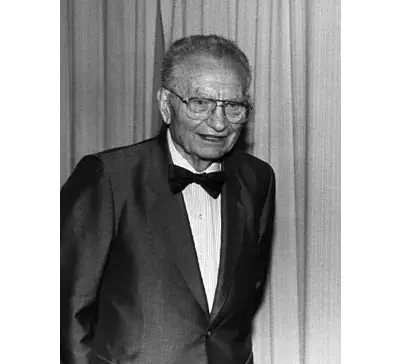
Paul Anthony Samuelson (May 15, 1915 – December 13, 2009) was an American economist who was the first American to win the Nobel Memorial Prize in Economic Sciences. When awarding the prize in 1970, the Swedish Royal Academies stated that he "has done more than any other contemporary economist to raise the level of scientific analysis in economic theory". Economic historian Randall E. Parker has called him the "Father of Modern Economics", and The New York Times considers him to be the "foremost academic economist of the 20th century".
