Tariq Ramadan Quotes
Conspiracy theories are the way Muslims avoid facing up to their responsibility to be self-critical.
Tariq Ramadan, Egyptian Islamic Historian & Political Philosopher, Grandson of Hassan Al-Banna (founder of the Muslim Brotherhood), “Who’s Afraid of Tariq Ramadan?” Foreign Policy, November/December 2004
Sourced by: Eigen's Political and Historical Quotations

In September of 2005 a Danish Newspaper published some political cartoons showing the hypocrisy of some Muslims who use Islam to justify murder of innocents and terrorism. Many in the Middle East protested vehemently because the Prophet Muhammad's visage was depicted against Islamic tradition. Many Muslim leaders claimed that insulting religion was an “abuse” of freedom of speech including those from nations which regularly publish material that is virulent against Christians and Jews. Momani reprinted the cartoons and wrote this editorial arguing that the cartoons insulted Islam far less than the terrorism and murder—especially a recent murder of Muslims in Amman attending an Islamic wedding ceremony, He was fired by the newspaper owners and then actually arrested by the Jordanian authorities for “Insulting Religion.”
Ms. Moran would likely be outraged if a gun manufacturer would not sell her a gun on the grounds that as a Christian she can be assumed to agree with the dozens of verses in the Bible where God called on his followers to kill (and even mutilate), including the killing of insolent children. Most Christians do not take those commands literally just as most Muslims do not take her 109 verses literally. She also refused to allow brown skinned Hindus to patronize her range.


One of the many difficulties that Muslims have in understanding America is their perception that Islam is snubbed by the government. Separation of church and state is the exact opposite of the basic doctrines is Islam which holds that everything in society including government should be driven and controlled religiously. While that view was true of the Roman Catholic church at one time as well as some of the National Protestant churches, America is the antithesis. In general, where there is a ceremonial role that religions are given by government like prayer at the start of Congressional sessions, there are very few consultations of government officials with specific religions about government civil and secular policy and legislation. There are just too many religions in America and it would be impractical even if it were not against American tradition and even law in some cases.
Al-Omar is one of Saudi’s leading clerics and the Saudi Arabian government—supposedly is a major ally of the United States—not only tolerates this type of inflammatory rhetoric but it makes no effort to repudiate this and other radical Islamic statements. There is no freedom of Speech in Saudi Arabia, and people are arrested all the time for saying things that are displeasing to the Royal Family. But no attempt to suppress this kind of virulent anti-American attack.
The place of non-Muslims in an Islamic country, if any, has been a point of great anxiety among Christians, Jews, Bhais, and others. These have been persecuted and expelled from numerous Islamic countries while in others such as modern Turkey there is no problem. This particular cleric is seen as more “modern” and “liberal” than most. Even he has little concept of equality and freedom of religion.

Just days before September 11. While in America, such a remark would just be considered an insensitive and inappropriate utterance, in France, he was brought before the courts and threatened with jail and a large monetary fine under a 1972 French law which bans hate speech. See {595311}

In some countries political candidates run on religious platforms to convert the part of the population that is not of their religion and turn the nation into a theocracy.


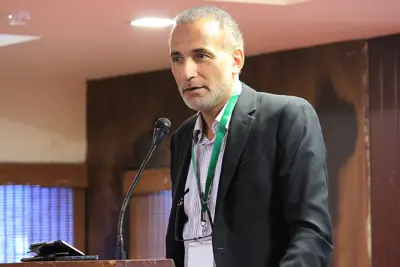
Tariq Ramadan is a Swiss Muslim academic, philosopher, and writer. He was a professor of contemporary Islamic studies at St Antony's College, Oxford and the Faculty of Theology and Religion, University of Oxford, but as of 2018 is taking an agreed leave of absence. He is a visiting professor at the Faculty of Islamic Studies at Hamad Bin Khalifa University in Qatar, and the Université Mundiapolis in Morocco. He is also a senior research fellow at Doshisha University in Japan. He is the director of the Research Centre of Islamic Legislation and Ethics (CILE), based in Doha. He is a member of the UK Foreign Office Advisory Group on Freedom of Religion or Belief. He was elected by Time magazine in 2000 as one of the seven religious innovators of the 21st century and in 2004 as one of the 100 most influential people in the world and by Foreign Policy readers (2005, 2006, 2008–2010, 2012–2015) as one of the top 100 most influential thinkers in the world and Global Thinkers. Ramadan describes himself as a "Salafi reformist".
