Warren E. Burger Quotes
Churches are excluded from the affairs of government. Important, discretionary, governmental powers may not be delegated to or shared with religious institutions.
Religious organizations may become grantees or contractors to perform various social services—along with other non-profit organizations provided, that they do not comingle the government contract money with the general church funds, that the services that are provided are provided to all regardless of religious beliefs, and that there is no religious ceremony or indoctrination in the provision of services. Catholic Charities and the Salvation Army are two of the larger religious organizations that receive government funds for general service provision. Those religions who do not want Federal Auditors reviewing their use of the money or who insist that prayer is a necessary aspect of the social services are the ones who have trouble and accuse the government of being hostile to religious social services.
Warren E. Burger, Chief Justice of the U. S. Supreme Court, Larkin v. Grendel’s Den, 1982
Sourced by: Eigen's Political and Historical Quotations


While this principle is very clear to us today, and was to the people who originally ratified The Constitution, there were many attempts by Christian groups to establish a privileged position for Christianity. For example, for years the Sunday Sabbath was legally enforced by unconstitutional Blue Laws that prohibited businesses from operating on the Christian Sabbath and prohibited activities that compete with Sunday church attendance. Supreme Court Justice Story even argued that the First Amendment allowed Christian religious supremacy and Cooley wrote this to refute Story’s now discredited doctrine.


This is a critical quotation on the government establishment of religion issue. There are a few people who have argued over the years that the Founding Fathers and their culture was religious and where they were careful to avoid favoring one religion over another, they did NOT intend to put atheism on the same equal plane as religion as far as government action is concerned. However, some of the Founding Fathers were atheists, and some others like John Adams were deists—they believed in a God but not in the Trinity or in Judaism or any organized religion. So this quotation makes it clear that the First Amendment does NOT favor religion over non religion or secularism. Atheism must be on an equal footing but not on a higher plane.

The State of New Jersey reimbursed parents of public and private school children when the children took public transportation to school. Parents of religious school children wanted the same reimbursement. The Court would not allow that. The vote was 5-4.


This is one of the key documents showing the “wall of separation of church and state” was in use in early America. Almost 200 years later the Chief Justice of the Supreme Court seemed ignorant of this communications. See William Rehnquist: {373663}

Madison, while a member of the House, had opposed the appropriation of funds for Congressional Chaplains and lost. Strict constructionists often quote his statements regarding Congressional Chaplains. Loose constructionists point to the fact that a majority of the Congress indeed appropriated the funds.


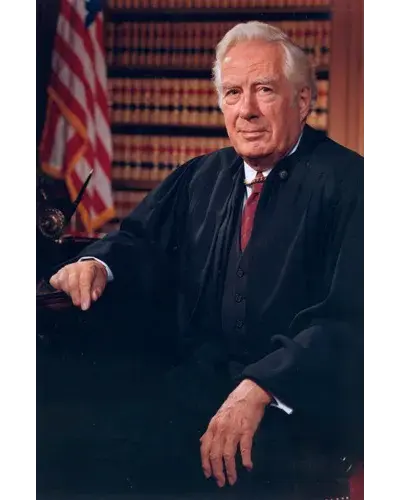
Warren Earl Burger was the 15th Chief Justice of the United States Supreme Court, serving from 1969 to 1986. Born in Saint Paul, Minnesota, Burger graduated from the St. Paul College of Law in 1931. He helped secure the Minnesota delegation's support for Dwight D. Eisenhower at the 1952 Republican National Convention. After Eisenhower won the 1952 presidential election, he appointed Burger to the position of Assistant Attorney General in charge of the Civil Division. In 1956, Eisenhower appointed Burger to the United States Court of Appeals for the District of Columbia Circuit. Burger served on this court until 1969 and became known as a critic of the Warren Court.
