Simone de Beauvoir Quotes
Christianity gave eroticism its savor of sin and legend when it endowed the human female with a soul.
There is much debate about the actual truth of this widely believed story. There may have never been such a debate at the Council. Some scholars believe the “rumor” confused the council meeting with that of a local Synod in France in 585 AD which is described in The History of the Franks by Gregory of Tours where such a debate did take place. However, although the Catholic Church by no means considered women equal to men, the female possession of a soul many argue was generally assumed by most clerics throughout history. They point to the fact that females had always been baptized and that there were early female Saints—concepts which would have been inconsistent with a general belief that women did not possess souls. De Beauvoir’s basic point however, is not dependent on the truth of the story, but can be made as a result of the fact that women had been raised sufficiently to possess souls, regardless of when and where in Church history.
Simone de Beauvoir, 1908-1986, French Author, View of the consequence of the Council of Nicea in 323 where many believed that the Council had decided by a single vote that women had a soul
Sourced by: Eigen's Political and Historical Quotations


This quotation gives us an insight into the sexual mores and its contrast with the teachings of Christianity ito the upper middle class n the American Colonial era. Guid was strong, but not strong enough to suppress the “evil” sexual activity.

He was running for the Republican Presidential nomination at that time.

His quotations are very important because he wrote many of the Islamic legal opinions that governed Muslim Spain and influenced the Arabs of North Africa. There are many in the modern world who tend to agree with this view of priestly celabicy especially in the light of the Roman Catholic Sex Scandals involving priests throughout the world of the beginning of the 21st century.


Wycliffe had come down with a serious illness and appeared to be dying. The friars gathered at his bedside assuming that he would repent his attacks on the church, the friars and the Pope with his last rites. Instead, he pronounced this famous line. The churchmen left in disgust waiting for him to die. But he did not and vexed the established church and its representatives for a few more years. Wycliffe was castigated and had his books burned for his attacks on priests and bishops. A thousand years earlier another man was canonized as a Saint for similar attacks. See {618186}

Jinnah was a modern Islamist who saw the role of females in a modern context. He, like the Indian Hindu leaders were in a sense products of the West and Western government and education. He would be very surprised that in his Pakistan men can murder their female relatives who they believe have dishonored the family, or that women would not be educated in the Madrassas, or that authorities could sentence a female relative of a man deemed guilty of seduction to be gang raped, but that is what happens in modern Pakistan. Jinnah and many of the early leaders believed that their new government could modernize Islam but the control and influence went the other way. Pakistan became a religiously dominated autocracy rather than the democracy that Jinnah foresaw.
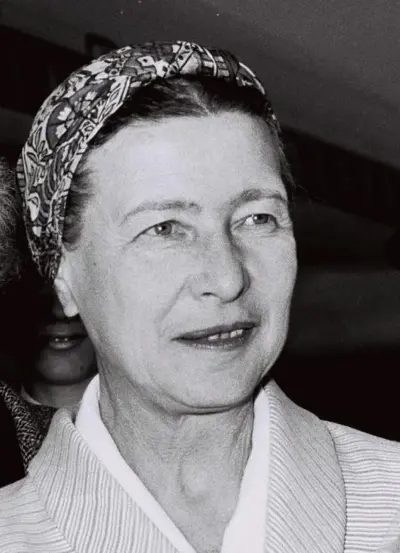
Simone Lucie Ernestine Marie Bertrand de Beauvoir was a French writer, intellectual, existentialist philosopher, political activist, feminist, and social theorist. Though she did not consider herself a philosopher, she had a significant influence on both feminist existentialism and feminist theory.
