George Berkeley Quotes
Casting an eye on the education of children, from whence I can make a judgment of my own, I observe they are instructed in religious matters before they can reason about them, and consequently that all such instruction is nothing else but filling the tender mind of a child with prejudices.
Berkeley, George. Alciphron: or, The Minute Philosopher. J. Tonson, 1732, vol. 1, Dialogue 1, sect. 11.


See {138145} for another variation of the same theme.
See {627272} for another variation of the same theme.


Santorum’s view was not quite as absurd as this quotation would indicate. His concern was that he believed that colleges and universities were dominated by left wing, liberal faculty, who indoctrinate the students and turn them into Democrats or liberal Republicans. This he thought was bad for the country. The view is not complete paranoia. Higher Education is rarely indoctrination in America. Virtually every school has some politically conservative faculty as well as faculty who are in the political left and some are apolitical. However most of the good schools are liberal in the traditional meaning of the word and as it has been used in Europe and initially in the United States. This liberal tradition is characterized by openness to all ideas and points of view including those that the government or other institutions of society are sometimes uncomfortable with. This intellectual tolerance makes some ultraconservatives uncomfortable. However, other political conservatives are very “liberal” in the intellectual sense including most of the great conservative writers and philosophers and economists of the last centuries. There are people of all political and religious persuasions in most societies who are concerned that the ideas young people might be exposed to are harmful to them and detrimental to society. Most have more faith in young people and see the major role of education is to expose the student to new and different ideas for the student to consider. Santorum is one of the former; all his Republican opponents were of the other point of view.

Adams and Benjamin Franklin served as Ministers to France to obtain assistance for the Revolution. Franklin was masterly successful in arranging French economic and military assistance. Adams however was not. He was very uncomfortable in Paris and the sexuality was particularly distressing to him. Franklin, in contrast, not only was not distressed but was a favorite amongst French ladies even at his advanced age.
This is one of the earliest statements in favor of government involvement in education. In a sense, it is this quotation that is fundamental to the concepts of public education and to government regulation of education.
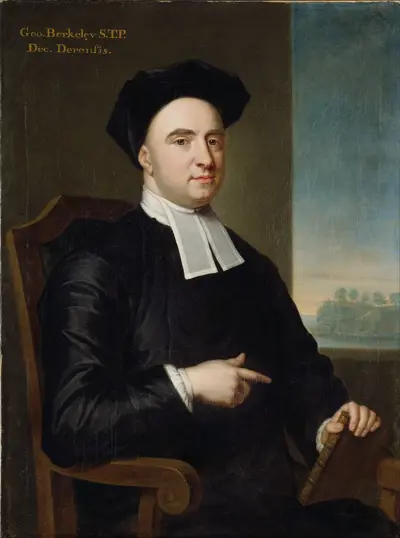
George Berkeley – known as Bishop Berkeley (Bishop of Cloyne of the Anglican Church of Ireland) – was an Anglo-Irish philosopher whose primary achievement was the advancement of a theory he called "immaterialism" (later referred to as "subjective idealism" by others). This theory denies the existence of material substance and instead contends that familiar objects like tables and chairs are ideas perceived by the minds and, as a result, cannot exist without being perceived. Berkeley is also known for his critique of abstraction, an important premise in his argument for immaterialism.
