Donald Cargill Quotes
But go on, valiant champion; you die not as a fool, though the apostate, unfaithful, and lukewarm ministers and professors of this generation think and say so.
Cargill, Donald. "Letters of Mr. Donald Cargill." A Cloud of Witnesses for the Royal Prerogatives of Jesus Christ, edited by John H. Thomson, Johnstone, Hunter, & Co., 1871.


This sura is interpreted in two ways. For many modern Muslims it means that in discussions and debates on religion with non-Muslims, do not back off, and if you do it is a religious transgression. Defend the faith. For the fundamentalists and extremists, they interpret the same sura in physical warlike terms. So if there is a fight or battle with disbelievers, retreating from the battlefield is not only cowardice and perhaps a crime under military regulations as it is in the West, but it is in Christian terms a mortal sin for which there one will go to hell. So the most religious of Muslims will fight to the death using this sura as their guidance. On the other hand, Muhammad himself as the military and civil leader of Islam made strategic retreats. In the history of almost all warfare between the West and Muslims—especially the Arabs—courage on the battlefield has been lacking and the Israelis, British, French, Americans, and Hindus of India all observe this military weakness and accounting for this is built into their military doctrine.


Hill was tried for a murder he claimed he didn’t commit, but he refused to take the stand and explain his gunshot wound. He refused to provide the names of the people who were involved in his shooting. By today’s legal standard there was no proof of his guilt, but his refusal to testify or even provide the information to the Governor after his conviction. He was executed by Utah by firing squad in 1915.

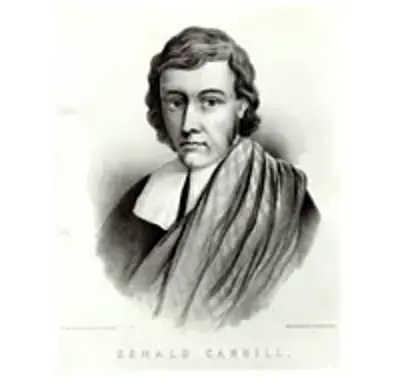
Donald Cargill was a Scottish Covenanter who worked to uphold the principles of the National Covenant of 1638 and Solemn League and Covenant of 1643 to establish and defend Presbyterianism. He was born around 1619, and was the eldest son of Laurence Cargill of Bonnytoun, Rattray, Perthshire, a notary public, and Marjory Blair. He was educated perhaps at University of Aberdeen and at the University of St Andrews, where he matriculated as a student of St Salvator's College in 1645. He was licensed by the Presbytery of St Andrews on 13 April 1653 and was ordained in 1655. He was later deprived by the Privy Council, on 1 October 1662, for disobeying the Act of Parliament in not keeping a day of thanksgiving for His Majesty's Restoration, and not obtaining presentation and collation from the archbishop before 20 September. He was ordered at the same time to remove beyond the Tay before 1 November under penalties. Disregarding this sentence, he was charged to appear before the Council on 7 January 1669, and appointed to continue in his confinement, but on petition he was allowed to visit Edinburgh about law affairs. He refused an indulgence at Eaglesham on 3 September 1672. On 16 July 1674 a decreet was passed against him for holding conventicles. In 1679 he joined Richard Cameron in founding the Cameronians (afterwards the Reformed Presbyterians), who embodied their principles in a Declaration at Sanquhar, on 22 June 1680, disowning the king's authority. A reward of 3000 merks was offered for his apprehension, dead or alive. For excommunicating at Torwood in September 1680 Charles II., James, Duke of York, and others, the Privy Council increased the reward to 5000 merks. After numerous hair-breadth escapes he was apprehended at Covington Mill, Lanarkshire, during the night of 12 July 1681 by a party of dragoons led by James Irving of Bonshaw (who got the reward). Tried for treason before the High Court of Justiciary, he was found guilty, and executed at the Cross of Edinburgh with four others [Walter Smith, William Cuthil, William Thomson, James Boig], 27 July 1681. His forfeiture was rescinded by Act of Parliament 4 July 1690. He married Margaret (died 12 Aug. 1656, within a year and a day of their marriage), daughter of Nicol Brown, burgess of Edinburgh, widow of Andrew Bethune of Blebo.
