Ernst Haeckel Quotes
Both of these branches of evolutionary science, are, in my opinion, in the closest causal connection; this arises from the reciprocal action of the laws of heredity and adaptation.
Haeckel, Ernst. The Evolution of Man: A Popular Exposition of the Principal Points of Human Ontogeny and Phylogeny. Vol. 1, D. Appleton and Company, 1879, p. 2.

This quotation from this letter was one of the key items of evidence showing that Wallace had independently developed the concept of Evolution before Darwin published his famous treatise. Darwin began formulating his theory of natural selection in the late 1830s but he went on working quietly on it for twenty years. He wanted to amass a wealth of evidence before publicly presenting his idea. During those years he corresponded briefly with Wallace (right), who was exploring the wildlife of South America and Asia. Wallace supplied Darwin with birds for his studies and decided to seek Darwin's help in publishing his own ideas on evolution. He sent Darwin his theory in 1858, which, to Darwin's shock, nearly replicated Darwin's own…. Joseph Dalton Hooker arranged for both Darwin's and Wallace's theories to be presented to a meeting of the Linnaean Society in 1858. However, Wallace seems to have been onto the idea of evolution over a decade before as this quotation shows.


Evolution sometimes produce or retain components that have no purpose or are even inefficient. But he is urging the biologist to remember that none of the life form were designed much less designed efficiently. We humans have an appendix for example, which does nothing positive and sometimes gets infected and kills us. Yet it is still there. We have so much else on the positive side that a few weaknesses are not material to our survival.


As early as this was in scientific history, he essentially described the process whereby new species are formed by the mutation from the old series.

Darwin did not develop an interest in the origin of life in a vacuum. His grandfather and many other scientists and naturalists had realized that species evolved and improved over tome and generations. What Charles Darwin added was the principles of the mechanism of how it all worked.

Referring to the impeached governor of Arizona:

Here the Governor makes a very common error of people who do not have scientific training. They believe that a Scientific Theory is an assertion that has not yet been proven. That is not the way scientists use the term. The Theory of Relativity, Theory of Quantum Mechanics and Theory of Evolution all scientifically refer to a major set of scientific statements and relationships that have been proven over and over again, together with many corollaries and deductions. It is an established, experimentally proven body of knowledge that is still producing additional hypotheses that then need to be proven or refuted. The scientific THEORY is as high as it gets on the scientific scale of proof. The word “theory” used in science is not one fact, but a large set of related facts and their proofs. What the Governor refers to, scientists call hypotheses or speculations. There have been many more proofs of evolution -–many thousands of them—than proofs of Relativity which is actually harder to prove and only has a few thousand proofs. More important, not one person has ever been able to prove scientifically that any of the assertions of evolution are false. Some religions have no difficulty with evolution (Roman Catholics for example) and a few do (fundamentalist Protestants for example). Governor Huckabee was also a fundamentalist Protestant minister. Even the Federal courts have held that the objections and so called “refutations” and alternatives to evolution are religious and not scientific, and hence may not be taught as science in public schools. Non evolution (like creationism) is a religious and cultural notion and should be studied as that.


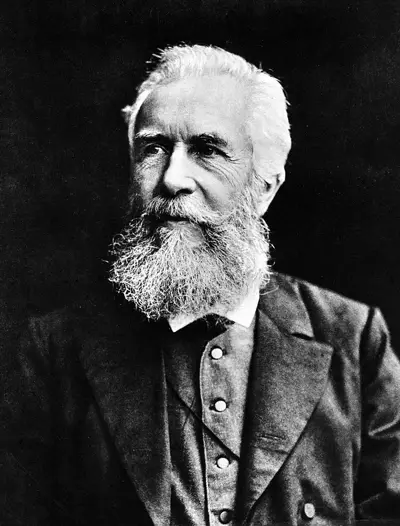
Ernst Heinrich Philipp August Haeckel (German: [ˈʔɛɐ̯nst ˈhɛkl̩]; 16 February 1834 – 9 August 1919) was a German zoologist, naturalist, eugenicist, philosopher, physician, professor, marine biologist, and artist who discovered, described and named thousands of new species, mapped a genealogical tree relating all life forms, and coined many terms in biology, including ecology, phylum, phylogeny, and Protista. Haeckel promoted and popularised Charles Darwin's work in Germany and developed the influential but no longer widely held recapitulation theory ("ontogeny recapitulates phylogeny") claiming that an individual organism's biological development, or ontogeny, parallels and summarises its species' evolutionary development, or phylogeny.
