Stokely Carmichael Quotes
Black power can be clearly defined for those who do not attach the fears of white America to their questions about it.
Carmichael, Stokely, and Charles V. Hamilton. Black Power: The Politics of Liberation in America. Random House, 1967, p. vi.


This was the speech that started the "Black Power" Movement. The rally was held in a city park to Protest the murder just 10 days before of the civil rights activist, James Meredith. It also marked the break between the Student Nonviolent Coordinating Committee (SNCC) and the nonviolent movement lead by Martin Luther King. Because of that, the speech received so much publicity that "Black Power" became a significant political term instantly.

This appears to be the first use of the phrase "Black Power."


This phrase was also to be used over 100 years later by Malcolm X. See {624101} and {38291}.


Vladimir Lenin. In their quest for world revolution, the Russian Communists had more problems with arguments in the United States whose reforms and economy had produced a very high standard of living. They knew that to effect a revolution, they had to reach the middle class and the intellectuals. They had little economically to attack America with but they were able to attack the United States morally. Even though segregation was legal in America at that time, many Americans thought it immoral. Most of the rest of the world did also. So that was one of the attack points. Since the communists opposed U. S. racial segregation, many Southern segregationists used a perverted logic and accused everyone who opposed segregation of being a communist. In addition to racial segregation, the Communists attacked other forms of discrimination such as anti-Catholic, anti-Asian, and anti-Semitic (See {638737} ) behavior.


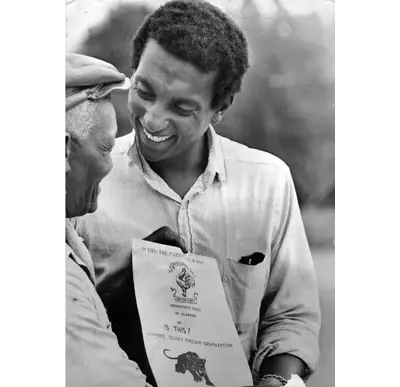
Kwame Ture was a prominent organizer in the civil rights movement in the United States and the global Pan-African movement. Born in Trinidad, he grew up in the United States from the age of 11 and became an activist while attending the Bronx High School of Science. He was a key leader in the development of the Black Power movement, first while leading the Student Nonviolent Coordinating Committee (SNCC), then as the "Honorary Prime Minister" of the Black Panther Party (BPP), and last as a leader of the All-African People's Revolutionary Party (A-APRP).
