Theodore Roosevelt Quotes
Behind the ostensible government sits enthroned an invisible government owing no allegiance and acknowledging no responsibility to the people
In TR’s era, major corporations and trusts controlled many Federal, State, and local officials by various methods, the Most pernicious of which was bribery. Most major corporations had their own legislators, judges and executive officials.
Theodore Roosevelt, 1858-1919, 26th President of the United States (Republican, NY) Quoted in Brian Andrews, “Millions Spent to Confuse Public About Geoengineering”, Conscious Life News, May 11th, 2011, http://consciouslifenews.com/millions-spent-confuse-public-geoengineering/116250/
Sourced by: Eigen's Political and Historical Quotations


Roosevelt was running again for the presidency, however this time as a Third Party Candidate. He lost to Woodrow Wilson but outpolled the Republicans. This was the Third Party performance since Abraham Lincoln.


Corporatism is an English word that describes a nation, government agency, or other large entity that has been influenced heavily, taken over, or controlled by a special interest group.


President Andrew Jackson was the first President who went after them. The mechanism of these men has been bribes, much more common in early and middle America than today where campaign contributions are a legalized way of the wealthy having more influence on the control of the country. The other way was by the control of the money supply, the markets and banking. Jackson would not go along with allowing a small number of very wealthy bankers to control the monetary policy of the country. In modern times, there are a number of left and right wingers who see the private Federal Reserve Bank and its secrecy as an example of what Roosevelt was referring to,

Wilson was an intellectual who did not rise in politics through the political system of the time and was not only somewhat shocked by the power of different pressure groups and economic forces, but was thwarted by many of them.


A decade after 9-11, Priest was the journalist who created the Washington Post history of the “War on Terror.”

Today, we assume that corporations including banks chartered by State and Federal governments would hire lobbyists and use their money for political elections. However, in 1833, that was so shocking to public morality that the President addressed it in his State of the Union Address and it was the subject of countless debate. Interestingly, the body politic was equally, if not more, shocked by the fact that the Bank was trying to manipulate public opinion. Jackson and the politicians of that day would take a very dim view of corporate activities today.


Abramoff had bribed over 100 Congressional offices by a combination of campaign donations, paid golf junkets all over the world, free elegant meals at his own fancy Washington Restaurant, free tickets for the Congressmen, their staffs and their major constituents, to Concerts and sporting events including his own Skyboxes, and promises of future employment at very high salaries. Ironically, we was convicted of cheating some of his lobbying clients and did a jail term, but his “bribery” was technically usually legal. In addition to Abramoff, only one Congressman was charged and convicted of corruption, when many if not most had engaged in these corrupt practices. Congress makes the rules with loopholes so that what is bribery and corruption in any other setting is often not against the law if Congress is involved.


The Bank was privately owned. Jackson was a major opponent of the Bank. See his description {630650} .
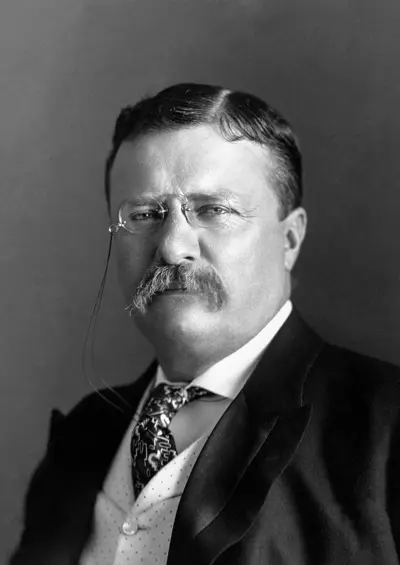
Theodore Roosevelt Jr., often referred to as Teddy or his initials T. R., was an American statesman, conservationist, naturalist, historian, and writer, who served as the 26th president of the United States from 1901 to 1909. He previously served as 33rd governor of New York from 1899 to 1900 and the 25th vice president of the United States from March to September 1901. Roosevelt emerged as a leader of the Republican Party and became a driving force for anti-trust and Progressive policies.
