Charles Lindbergh Quotes
Aviation seems almost a gift from heaven to those Western nations who were already the leaders of their era, strengthening their leadership, their confidence, their dominance over other peoples.
Lindbergh, Charles A. "Aviation, Geography, and Race." Reader's Digest, Nov. 1939, p. 64.


Two years later he flew. That is how fast and dramatic the Wright Brothers work had gone. Once they got on the right track, everything began to fall into place. Two years earlier he had been optimistic. See {613170}.


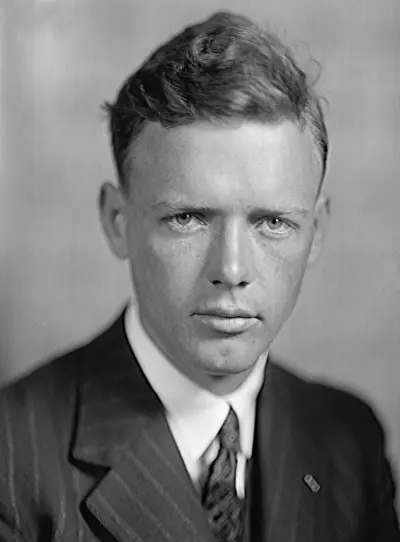
Charles Augustus Lindbergh, nicknamed Slim, Lucky Lindy, and The Lone Eagle, was an American aviator, author, inventor, military officer, explorer, and social activist. In 1927, at the age of 25, Lindbergh emerged from the virtual obscurity of a U.S. Air Mail pilot to instantaneous world fame as the result of his Orteig Prize-winning solo nonstop flight from Roosevelt Field on Long Island, New York, to Le Bourget Field in Paris, France. He flew the distance of nearly 3,600 statute miles (5,800 km) in a single-seat, single-engine, purpose-built Ryan monoplane, Spirit of St. Louis. Lindbergh was the 19th person to make a Transatlantic flight, the first being the Transatlantic flight of Alcock and Brown from Newfoundland in 1919, but Lindbergh's flight was almost twice the distance. The record-setting flight took 33 1⁄2 hours. Lindbergh, a U.S. Army Air Corps Reserve officer, was also awarded the nation's highest military decoration, the Medal of Honor, for his historic exploit. Politically, the National Hero became an active fascist supporter of Mussolini and Adolph Hitler who awarded him a Medal for Supporting Fascism, Anti-Semitism and advocating for America to allow Hitler to conquer German and the rest of Europe. After WWII he was in disgrace.
