John M. Grunsfeld Quotes
At the age of six, I declared that I wanted to be an astronaut. My mother thought that was just fine, as it would encourage me to learn science, and besides, there really was no chance I would ever actually become an astronaut.
Grunsfeld, John M. Interview by Rebecca Wright. NASA Johnson Space Center Oral History Project, National Aeronautics and Space Administration, 20 June 2007.


If we do not have more scientific graduates from the university we will lose contact with modernity.
One of his major initiatives was to reform the Italian university curriculum to have more scientific offerings. Italy historically has been a great scientific culture ranging from Galileo to Enrico Fermi, but in recent times the universities have not had strong scientific curricula.

She had just defeated the previous board chairwoman, Linda Holloway,who had voted with the majority the previous year to revise the standards so that evolution would not be included. See Linda Holloway {603677}.


In September, 2007, Vitter earmarked $100,000 in federal money for a Christian group, the Louisiana Family Forum, known for challenging evolution by means of "teaching the controversy" which promotes intelligent design. When the earmark became public, other legislators pressured Vitter to withdraw is earmark which he did in October of 2007. Vitter had been a major opponent of spending federal money for education, but made an exception for this project. Vitter’s hypocrisy extended to his own behavior as well. See {625898}.

Also published in What Do You Care What Other People Think, 1988. This was his last publication. He realized that NASA was under so much political and public relations pressure, that important science issues could not be faced squarely. So he wrote his own appendix to the report which was embarrassing to some of the administrators and contractors but was really appreciated by almost all of the scientists and engineers.


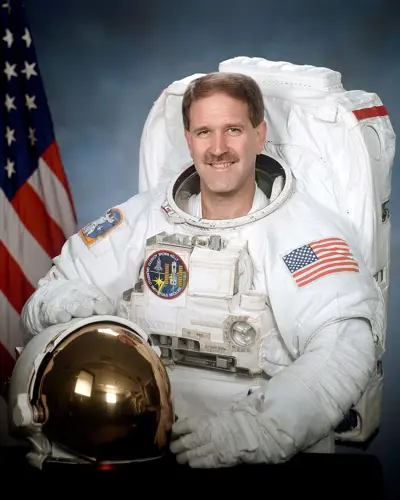
John Mace Grunsfeld is an American physicist and a former NASA astronaut. He is a veteran of five Space Shuttle flights and has served as NASA Chief Scientist. His academic background includes research in high energy astrophysics, cosmic ray physics and the emerging field of exoplanet studies with specific interest in future astronomical instrumentation. After retiring from NASA in 2009, he served as the Deputy Director of the Space Telescope Science Institute in Baltimore, Maryland. In January 2012, he returned to NASA and served as associate administrator of NASA's Science Mission Directorate (SMD). Grunsfeld announced his retirement from NASA in April 2016.
