Albert Einstein Quotes
As soon as science has emerged from its initial stages, theoretical advances are no longer achieved merely by a process of arrangement. Guided by empirical data, the investigator rather develops a system of thought which, in general, is built up logically from a small number of fundamental assumptions, the so-called axioms. We call such a system of thought a theory. The theory finds the justification for its existence in the fact that it correlates a large number of single observations, and it is just here that the 'truth' of the theory lies.
Einstein, Albert. "The Mechanics of Newton and Their Influence on the Development of Theoretical Physics." Ideas and Opinions, Crown Publishers, 1954, p. 254.


He was addressing the misunderstanding that many laypeople and most anti-evolutionists have that if Evolution is only a theory why put so much stock in it. The layman often uses the word “theory” in opposition to “fact.” But to the scientist theories are of different types—those that are as of yet speculation and those for which a strong body of evidence exists. Evolution, like Relativity, has a huge amount of evidence supporting it. Yet in time every good scientist knows that all these proven theories will be modified with new knowledge. Relativity has been demonstrated as having errors initially by Einstein himself. The essence of these things are true although elements change. The early law of gravity is the best example. We know that it is wrong in many, circumstances—in space for example. But it, none the less, is fundamental to much analysis and with our much more sophisticated understanding of it we still talk of the “Law” of gravity even though we realize that it is not quite correct in all circumstances.


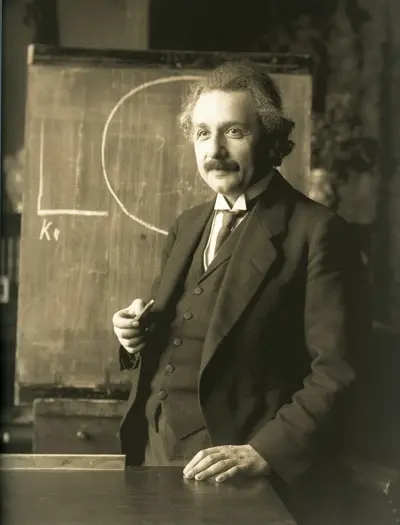
Albert Einstein was a German-born theoretical physicist, widely acknowledged to be one of the greatest physicists of all time. Einstein is known for developing the theory of relativity, but he also made important contributions to the development of the theory of quantum mechanics. Relativity and quantum mechanics are together the two pillars of modern physics. His mass–energy equivalence formula E = mc2, which arises from relativity theory, has been dubbed "the world's most famous equation". His work is also known for its influence on the philosophy of science. He received the 1921 Nobel Prize in Physics "for his services to theoretical physics, and especially for his discovery of the law of the photoelectric effect", a pivotal step in the development of quantum theory. His intellectual achievements and originality resulted in "Einstein" becoming synonymous with "genius".
