Charles Lyell Quotes
Hitherto, no rival hypothesis has been proposed as a substitute for the doctrine of transmutation; for 'independent creation,' as it is often termed, or the direct intervention of the Supreme Cause, must simply be considered as an avowal that we deem the question to lie beyond the domain of science.
Lyell, Charles. The Geological Evidences of the Antiquity of Man. John Murray, 1863, p. 469.

At the time, it was very difficult for people who had been taught all their lives that God was directly responsible for the creation to accept the notion of evolution. At the time, there was not the overwhelming evidence proving Darwin’s theory that we have today. Nor did theologians realize that evolution and Darwinism were not inconsistent with the concept of a creator and supreme being. Nonetheless, there are still those who, like Agassiz, reject evolution and insist that the Biblical version of creation is literally true. See {586990}. Then there are people who have come up with the concept of Intelligent Design which originated with Agassiz though he never called it that. Most religious people today, in contrast, see no conflict in natural selection as described by Darwin and later proven, and the concept of God. They see the Biblical creation as metaphorical and natural selection as the product of an omniscient supreme being.


The Bible contains two separate and somewhat contradictory versions of creation (Adam & Eve vs. the 6 day creation).

Ms. Holloway had led the majority of the board that had voted to revise the education standards of Kansas to exclude evolution. She was defeated in the Republican primary election afterward. See Sue Gamble {602752}


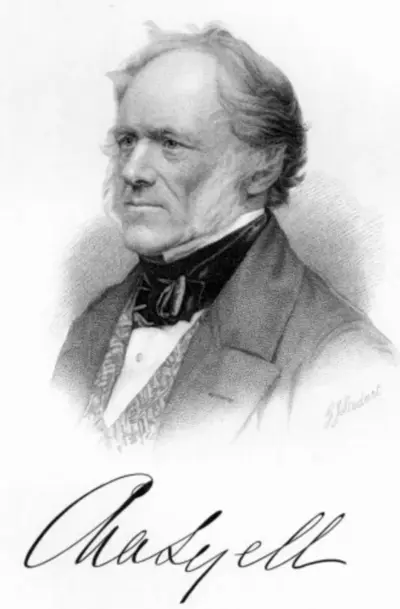
Sir Charles Lyell, 1st Baronet, FRS was a Scottish geologist who demonstrated the power of known natural causes in explaining Earth's history. He is best known as the author of Principles of Geology (1830–33), which presented to a wide public audience the idea that Earth was shaped by the same natural processes still in operation today, operating at similar intensities. The philosopher William Whewell termed this gradualistic view "uniformitarianism" and contrasted it with catastrophism, which had been championed by Georges Cuvier and was better accepted in Europe. The combination of evidence and eloquence in Principles convinced a wide range of readers of the significance of "deep time" for understanding the Earth and environment.
