Robert A. Dahl Quotes
As in Athens, the right to participate was restricted to men, just as it was also in all later democracies and republics until the twentieth century.
Dahl, Robert A. On Democracy. Yale University Press, 1998, p. 14.


Hunt gave as an example Mary Smith of Stanmore. This quotation is very interesting in the history of women’s suffrage. Hunt was a strong advocate for Universal Suffrage (See {616653}.) At the time, even men had to be a taxpayer and own a sufficient amount of property to vote. Less than 20% of the population of Britain were allowed to vote. The argument at the time was that the husband would represent the family’s interest at the ballot box and there was no need for women to vote. But by facing parliament with the logical inconsistency of its position, he was able to make his point, although there were very few women like Mary Smith who were single and had the economic resources to qualify. Most widows remarried so even if they had economic resources, there was a man who could assume the then perceived role of head of the household.


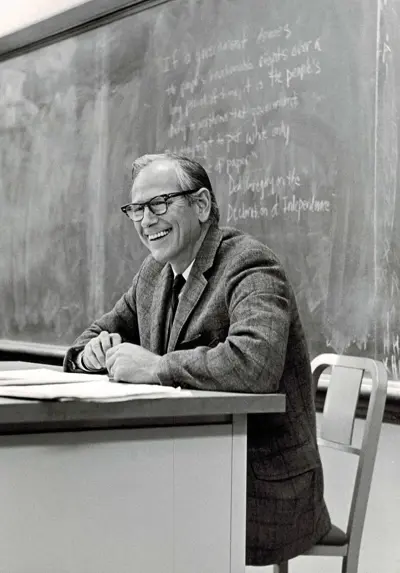
Robert Alan Dahl was a political theorist and Sterling Professor of Political Science at Yale University. He established the pluralist theory of democracy—in which political outcomes are enacted through competitive, if unequal, interest groups—and introduced "polyarchy" as a descriptor of actual democratic governance. An originator of "empirical theory" and known for advancing behavioralist characterizations of political power, Dahl's research focused on the nature of decision making in actual institutions, such as American cities. He is the most important scholar associated with the pluralist approach to describing and understanding both city and national power structures. In addition to his work on the descriptive theory of democracy, he was long occupied with the formulation of the constituent elements of democracy considered as a theoretical but realizable ideal. By virtue of the cogency, clarity, and veracity of his portrayal of some of the key characteristics of realizable-ideal democracy, as well as his descriptive analysis of the dynamics of modern pluralist-democracy, he is considered one of the greatest theorists of democracy in history.
