Albert Einstein Quotes
As far as the laws of mathematics refer to reality, they are not certain, and as far as they are certain, they do not refer to reality.
Albert Einstein, 1879-1955, Nobel laureate in Physics$Einstein, Quoted in F. Capra, The Tao of Physics
Sourced by: Eigen's Political and Historical Quotations


There are many systems of mathematics which are totally contrary to the world as we know and observe it; others, reflect the world as it is known. The latter we use for science. The former exist only in the mathematics world. We have mathematics today of computers that do not exist, universes that can only be imagined and some that are not even imaginable. Sometimes we realize that a mathematical system we thought had no reflection of reality, was really useful in explaining a new physical phenomenon. What is theoretical today, might need to be applied tomorrow.

This quotation is important because it illustrates a common problem politicians have with funding science and mathematical research. Actually, so far many millions of dollars have gone into studying and developing methods of producing random numbers and sequences of them which are extremely important to many branches of science and essential to the operation of computers. Yet to the layman, the expense of public money to find better ways to pick random numbers seems totally absurd. Just pick one or use any random number. However, it is virtually impossible for a human being to truly randomly pick a number from 1-999. Most methods produce biases which invalidate the randomness. But this is very counter intuitive. So much decision making about scientific funding and policy is counter intuitive to the politician and the general public.


3rd Earl Russell of Kingston. In mathematics the numbers can count people, autos, sins, molecules, or paintings. The mathematician does not know or care. And the mathematics is the same regardless. And the fundamentals themselves are unknown. For example, what is a number? It’s not the symbol we write; that is a numeral. Some say that it is an abstract idea that represents a quantity like 5. But what is 5? That itself is an abstraction. So few mathematicians and no layman know what they are talking about when they do mathematics. Lord Russell, with his colleague Whitehead, built up a system where they could define a number as a set with certain properties. But they take 3 large volumes full of equations in a small type font to just get to 3rd grade arithmetic and knowing what they are talking about. In politics, we also often do not know what we are talking about, but that is for a much simpler set of reasons.

See {234968} for an earlier, similar view.


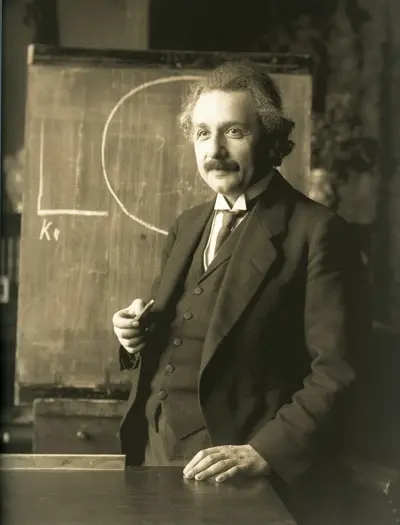
Albert Einstein was a German-born theoretical physicist, widely acknowledged to be one of the greatest physicists of all time. Einstein is known for developing the theory of relativity, but he also made important contributions to the development of the theory of quantum mechanics. Relativity and quantum mechanics are together the two pillars of modern physics. His mass–energy equivalence formula E = mc2, which arises from relativity theory, has been dubbed "the world's most famous equation". His work is also known for its influence on the philosophy of science. He received the 1921 Nobel Prize in Physics "for his services to theoretical physics, and especially for his discovery of the law of the photoelectric effect", a pivotal step in the development of quantum theory. His intellectual achievements and originality resulted in "Einstein" becoming synonymous with "genius".
