Winston Churchill Quotes
Arm yourselves, and be ye men of valor, and be in readiness for the conflict; for it is better for us to perish in battle than to look upon the outrage of our nation and our altar.
Churchill, Winston. "Be Ye Men of Valour." Broadcast address. 19 May 1940, London.


Winston Churchill utilized this quotation in his first radio address as Prime Minister, May 19, 1940
Nearly two years after Tripoli had declared war against the United States, the U.S., after much deliberation, decided to stop negotiating a tribute settlement with Tripoli. The U.S. launched their attack on June 11, 1803 in what would be the first amphibious operation on the Barbary Coast. After witnessing the operation, the Pasha was unmoved. Piracy and war was a way of life for the Barbary states.

He drove the British into the sea when no one expected that outcome.


It is not clear whether their manifesto was written by D’annunzio himself or followers in Fiume the Dictatorial mini-state that he ruled, He was a precursor to the Fascists of Europe and this is the origin of the Fascist glorification of war. Hitler and Mussolini also picked up the dagger as a symbol (see Quotation 643744), the black colored uniforms and the stiff-armed salute from D’annunzio.

He was leading the Gordon Highlanders of the British Army against the Boers during the Boer War. He was seriously wounded and could not go on himself with a charge he had ordered, However, waifing his sword he made this famous qutation. Particualrly noteorthy is the derrogatory terms which he used to describe the enemy--the Boers of South Africa. In many wars and cultures, one or more of the combatants, in order to overcome the avarage soldier's reluctance to kill an enemy, characterizes them as less than human. In this case, vermin, who were to be exterminated. There were two predominant groups of whites who came to South Africa, the English who were generally well-educated and were interested in trading with the exhisting inhabitants and investing in businesses using mostly native labot and the Boers. The latter were of Dutch and German origin, poor farmers with little or no land in the home country and little education. Their interest was to create a nation where they could own land to farm. And the lest expensive way for them to increase their farmland was to sieze it from the native Blacks and who were the major forces behind the racial discrimination which became apartheid. The British contolled the government and sought stability and as in most of the British Empire, they wanted English law to prevail including the rights of the Black natives. The Boers had left Europe for good and would thrive or not in Southern Africa. Proportiopnately, the English might have a career in South Africa or serve there for a few years. They were Englishmen in a foreign country. The Boers saw themselves as citizens of Southern Africa who were fighting the native Blacks for control of the land. The English legal system would not allow any of the land seizures and political discrimination that the Boers saw as existential for their survival in Africa. Soon, the Boers took more and more of the law into their own hands and saw English rule and dmination as inimical to their interests in Africa and they tried to create their own independent states in Southern Africa. That was the essense of the Boer Wars. Dick-Cunyngham was awarded the Victoria Cross, the highest military decoration of Great Britain, for his exploits in the Afghan War.


Mengustu seized power in a coup. However his Marxist Dictatorship was very unpopular and a civil war soon started. The poorly armed opposition used guerrilla warfare insurgency techniques. Since the government was hated by most people there was much support for the guerrilla in the villages and countryside. Mengustu adopted a policy of genocide. The areas of the country which were sympathetic to the revolutionaries were then systematically starved by the government withholding food. There was a bad agricultural crop but international donors including the United States provided much food aid. However this was withheld by the government from the areas where there was any support for the freedom fighters. Over 1 million Ethiopian citizens were starved to death. This quotation was one of the important documents that proved that there was a systematic government policy to commit genocide—in this case to “drain the sea”. After the revolution was successful, Mengustu was convicted of Crimes Against Humanity but escaped to Zimbabwe where he was given sanctuary by his fellow dictator, Robert Mugabe. There is a technical issue of whether or not this was genocide in that the exterminated people were not of one race, religion or ethnic group, but the people who were residents of the areas which were giving “aid and comfort” to the freedom fighters.

The Emperor had sent a challenging message to the young Ottoman Sultan {634798}. Constantine would not negotiate terms of surrender despite the overwhelming strength of the Turkish forces. The Sultan attacked and took the city in a battle where not only was Constantine killed but a large part of his people as well. The Muslims have held Byzantium (Constantinople, now Istanbul) since.


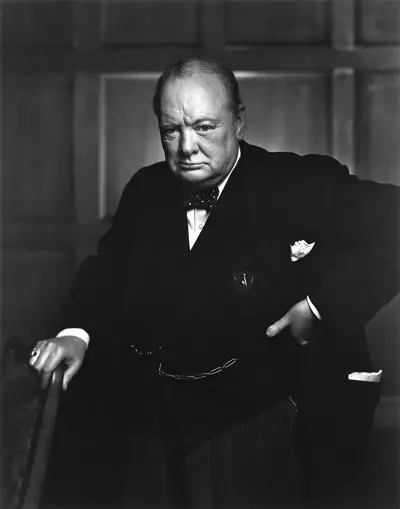
Sir Winston Leonard Spencer Churchill, KG, OM, CH, TD, DL, FRS, RA was the Prime Minister of the United Kingdom from 1940 to 1945, during the Second World War, and again from 1951 to 1955. Apart from two years between 1922 and 1924, Churchill was a Member of Parliament (MP) from 1900 to 1964 and represented a total of five constituencies. Ideologically an economic liberal and imperialist, he was for most of his career a member of the Conservative Party, as leader from 1940 to 1955. He was a member of the Liberal Party from 1904 to 1924. Churchill was also well known for his military career and as a historian, painter and writer, and among his many awards was the Nobel Prize in Literature.
