Mikhail Gorbachev Quotes
Apart from undeniable gains, there are still daily cares largely preventing women from enjoying their rights fully.
Mikhail Gorbachev, Russian President, Keynote Address, 19th All-Union Communist Party Conference, July, 1988
Sourced by: Eigen's Political and Historical Quotations


She was overly optimistic. She would be dead for 30 years before women got the vote and some would argue that full equality has not been reached yet.

She had been instrumental in changing the laws so that in most things women had equal rights, but they had not voted before, and did not read much about politics, and were not used to behaving as someone who had equal rights vis a vis anyone else.
Many politicians in that day would campaign from large carts drawn by oxen – a predecessor to the bandwagon of sorts. She was 1 of the 4 women who entered Oberlin College in 1837 thus becoming the first co-educational institution of higher education in the United States.

See Belva Lockwood {609865} for the view of the woman who lobbied heavily for the law and became the first woman to practice before the Supreme Court.

This quotation illustrates the statement of a reform principle to appease international interests in basic human rights. This type of statement provides the “fig leaf” for the UN and other organizations to pretend that international standards of human rights are being maintained. Nasser did not implement this principle. By the beginning of the 21st century, Egypt was finally making some progress on women’s equality issues. The prohibition on female members of Parliament—{586723}—had been reversed but women were still not allowed to be judges in a criminal trial, laws against infant female circumcision, and other elements of female equality were still not in existence.


It would take almost a thousand years for the relationship between women’s role in society, standard of living, poverty and development would be recognized by all but the most fundamentalist religious orders. Yet, at the flowering of Islamic intellectualism, the idea was discussed.


Marcus Porcius Cato. This quotation has had two different interpretations over time. One was that women if they received equality of treatment and voting would have an advantage for they also had their traditional “feminine wiles” and their sexuality, hence would dominate men. The second was a also a warning but based on the fact that women were superior in many ways, and given an equal chance, would excel men. The later interpretation is argued by some who point to the 2011 American data that shows more females than males graduating from high school and college, and females outnumber males in medical, law and several other professional schools. With the exception of a few Roman men, most heeded Cato’s warning and never took a chance on female equality.


Mrs. Roosevelt thought that with the rate of improvement in society’s perception and treatment of women was improving so steadily that women in America were not far from equality. Because of the shortage of men on the home front in WWII women had performed well in virtually all occupations including welding, heavy construction and management and it was just a matter of time to reach equality of pay and parity. However, she and most feminists did not take into account the 2 million men returning from military service who wanted their jobs back. Sexists, who had been suppressed during the war when they objected to women in non traditional occupations, were no longer silenced by national necessity. An occupational backlash developed. Then a sexual one regarding contraception and family planning, (Condoms for example were illegal up to 1963 as birth control device). Each major step forward was accompanied by its own backlash and even in the Presidential Campaign of 2012 contained debate on women’s control over their own bodies relative to abortion and contraception.


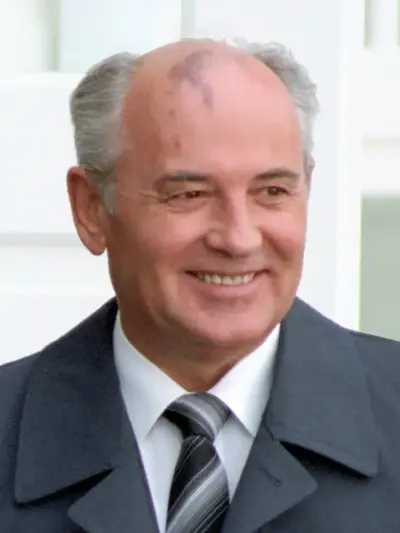
Mikhail Sergeyevich Gorbachev is a Russian and former Soviet politician. The eighth and last leader of the Soviet Union, he was the General Secretary of the Communist Party of the Soviet Union from 1985 until 1991. He was also the country's head of state from 1988 until 1991, serving as the chairman of the Presidium of the Supreme Soviet from 1988 to 1989, chairman of the Supreme Soviet from 1989 to 1990, and president of the Soviet Union from 1990 to 1991. Ideologically, Gorbachev initially adhered to Marxism–Leninism, although he had moved towards social democracy by the early 1990s.
