George Smathers Quotes
Anyway, so here I was caught between Johnson on the one side, who was my leader, I was his whip, and here was my dear friend, personal friend, Kennedy, and they're going to go into my state and ruin it. What am I going to do?
Smathers, George A. George A. Smathers: United States Senator from Florida. Interview by Donald A. Ritchie, Senate Historical Office, 1989.


President Johnson was trying to organize peace talks in Paris. Nixon didn’t want a public announcement to occur before election day when he was running against Hubert Humphrey. Knowing the South Vietnamese President was reluctant to go to Paris but was under pressure from America to do so, he sent a message through Chennault that he should not accept and “hang on” as Nixon would shortly win. The South Vietnam president refused to go to Paris, Nixon won the election, and then had to cope with the continuation of the war that might well have ended before he took office. Nixon believed that he could get Russia and China to pressure Ho Chi Min to make peace. Nixon's private overtures to the South Vietnam president, violated the Logan Act which prohiited private citizens negoatioating with foreign governments. President Johnson was aware of Nixon's commission of this felony want wanted to prosecute him, but the evicence had been obtained from secret intelligene agency bugging and wiretapping both the South Vietnam Embassay in Wishington and the Presidential Palace in Vietnam the public knowledge of which would have caused a scandal. Instead, he called Nixon and warned him to stop, but the damage had already been done, and the South Vitenamese government would not go to Pariis where they would have to agree to a coalition government with the Communists. THey waited for Nixon to deliver a peace treaty which would leave them in charge of South Vietnam. In the final analysis, the South Vietnamese ended up with nothing and no participation in anything when the U. S. Withdrew and the Communists took over.


LaPierre, who had a reputation for extreme statements, found many of his usual anti-gun control allies distancing themselves. See Gerald Ford {641384}.

In 1877 Wasburn was dropped from the List of Ministers by the Unitarian Church. He had become very critical of organized and orthodox religion of all kinds.

The meeting was to discuss continuing strategy for the Civil Rights Movement. There were, at this point, several different directions in which they could go. The irony of this meeting is that King was not pleased that most of the other leaders did not place the strategic importance of the Memphis strike that he did. They wanted him do appear in other venues for other purposes. His statement about getting killed was meant for the others to consider carefully how and why they wanted King to appear. In a few days, he was killed in Memphis—not implementing one of the other leader’s “brilliant” ideas, but implementing his own where most of them thought it of secondary importance and would prefer that he appear elsewhere instead. After King’s assassination, every leader at that meeting wished that he had been more persuasive in talking King out of the Memphis activity.


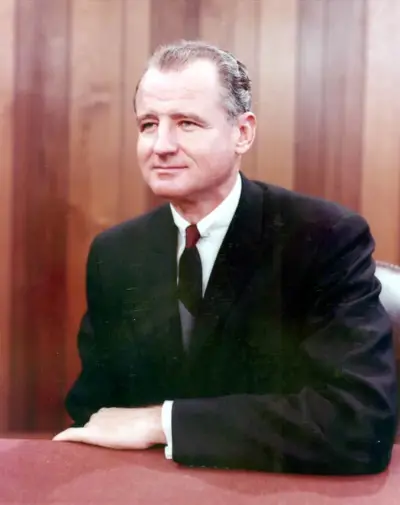
George Armistead Smathers was an American lawyer and politician who represented the state of Florida in the United States Senate from 1951 until 1969 and in the United States House from 1947 to 1951, as a member of the Democratic Party.
