Janis Karpinski Quotes
And shortly after that, when I try to get access to those soldiers, to ask them what in the world was going on, I was told that they did not work for me and I had no right to have access to any one of them.
Karpinski, Janis. "One Woman's Army: The Commanding General of Abu Ghraib Tells Her Story." Carnegie Council for Ethics in International Affairs, 22 Nov. 2005.


Miles, a hero of the Indian Campaigns (although he led the atrocities at the massacre at Wounded Knee) and then the leading military figure in America was an opponent of the policies of the new young President and had political aspirations of his own for the Presidency. Miles’ opinions were printed in the press. He maintained that he was not speaking as the Commanding General of the Army but personally as a citizen. The President surprised almost all by publicly scolding and reprimanding Miles when he next came to the White House. Five days later Roosevelt made the reprimand official, effectively ending Miles career. The issue of when senior military officers can criticize the administration has been debated ever since. Roosevelt was also a war hero himself, and although the military was shocked by such “savage” treatment of a senior officer, the President had public opinion on his side. Every decade or so there is a military official who does not care for the administration’s policies and expresses himself publicly. President Truman’s firing to General Douglas Macarthur was the most dramatic case, but Truman was well aware of the Miles and TR precedent.


Lawrence of Arabia


At the height of the Watergate scandal, the president wanted special prosecutor Archibald Cox fired, because Cox was developing evidence against the president. The attorney general, Elliot Richardson, refused to fire Cox and resigned. The chief of staff then turned to the deputy attorney general, William Ruckelshaus, who also refused and resigned. Finally, the Solicitor General, next in line of authority, agreed to fire the special prosecutor. These events happened on a Saturday night and became known as the “Saturday Night Massacre”. This event persuaded most Americans that Nixon was guilty of felonies and was desperately trying to cover things up. Congress would include “obstruction of justice” in it’s list of crimes that they would have impeached Nixon for had he not resigned.

The only soldier ever so honored. MacArthur had a huge ego, and was a shameless self-promoter. However he was never secure enough to have a personal staff of strong independent thinkers the way Dwight Eisenhower and most other high military officers did. The men who stayed on MacArthur’s personal staff tended to be sycophants and toadies and treated him like royalty, hence the remark by General Marshall.


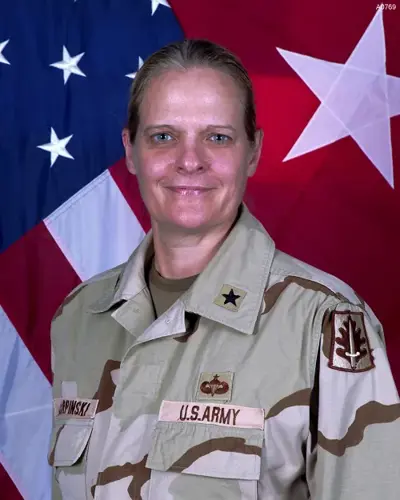
Janis Leigh Karpinski is a retired career officer in the United States Army Reserve. She is notable for having commanded the forces that operated Abu Ghraib and other prisons in Iraq in 2003 and 2004, at the time of the scandal related to torture and prisoner abuse. She commanded three prisons in Iraq and the forces that ran them. Her education includes a Bachelor of Arts degree in English and secondary education from Kean College, a Master of Arts degree in aviation management from Embry-Riddle Aeronautical University, and a Master of Arts in strategic studies from the United States Army War College.
