Anthony Kennedy Quotes
Americans have to have a link with their Constitution. They have to understand it in the context of their own time.
Anthony Kennedy, U.S. Supreme Court Justice, Testimony, House Appropriations Committee Hearing, April 12, 2005
Sourced by: Eigen's Political and Historical Quotations


From this quotation, {615902} and {615901} it is clear that the framers of the Constitution intended the treaty making powers to be shared by the President and the Senate. In practice, in modern times treaties are usually initially negotiated by diplomats under the supervision of the President and the Senate gets to concur or not in the ratification process. However, there have been a number of treaty failures including the League of Nations where the lack of coordination has resulted in a situation where the Senate had to accept or reject something which the President had negotiated and the Senate rejected the treaty.

The president was asked if he supported the Supreme court's school desegregation decision:


The Presidential election of 1800 produced a crisis even greater than that of 2000. There was an Electoral College tie between Thomas Jefferson and Aaron Burr—both of the same party, Democratic Republicans. The Federalist Party led by President John Adams had been totally rejected by the voters and Adams was in third place. However, the Federalists saw an opportunity of maintaining the Presidency anyway. The Constitution threw the election into the House of Representatives with each State delegation having a single vote. In the House, the Federalists had parity with Jefferson’s party which resulted in 35 tie votes. Finally, Congressman Bayard, the sole Congressman from Delaware, withheld his vote on the 36th ballot, thereby electing Thomas Jefferson of the opposition party. His reason was:
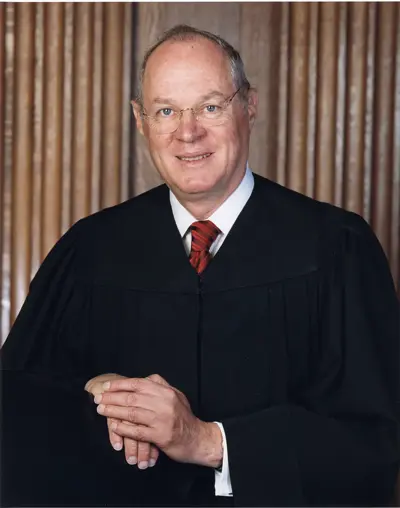
Anthony McLeod Kennedy is a retired American lawyer and jurist who served as an Associate Justice of the Supreme Court of the United States from 1988 until his retirement in 2018. He was nominated to the court in 1987 by President Ronald Reagan, and sworn in on February 18, 1988. After the retirement of Sandra Day O'Connor in 2006, he was the swing vote on many of the Roberts Court's 5–4 decisions.
