Nicholas Kristof Quotes
Americans have called on moderates in Muslim countries to speak out against extremists, to stand up for the tolerance they say they believe in. We should all have the guts do the same at home.
Nicholas D. Kristof, Political Columnist, "America's History of Fear", New York Times, September 4, 2010
Sourced by: Eigen's Political and Historical Quotations

Tragically, at the time, reasonable, moderate Muslims who did stand up at that time ran the personal risk of social, religious ostracism to physical attack and killing of them and their families.


He wrote this in the midst of the Salmon Rushdie affair where some Muslim clerics had issued a fatwa calling for the murder of the author because in this view his writings offended Islam.

In September of 2005 a Danish Newspaper published some political cartoons showing the hypocrisy of some Muslims who use Islam to justify murder of innocents and terrorism. Months later, in January of 2006 many in the Middle East protested vehemently and Muslim riots broke out because the Prophet Muhammad's visage was depicted against Islamic tradition. Many Muslim nations started a boycott against Denmark. Many Muslim leaders claimed that insulting religion was an “abuse” of freedom of speech including those from nations which regularly publish material that is virulent against Christians and Jews. In the United States a debate raged over whether or not news organizations should show the cartoons. Some did; most did not.

In September of 2005 a Danish Newspaper published some political cartoons showing the hypocrisy of some Muslims who use Islam to justify murder of innocents and terrorism. Months later, in January of 2006 many in the Middle East protested vehemently and Muslim riots broke out because the Prophet Muhammad's visage was depicted against Islamic tradition. Many Muslim nations started a boycott against Denmark. Many Muslim leaders claimed that insulting religion was an “abuse” of freedom of speech including those from nations which regularly publish material that is virulent against Christians and Jews.


He was assassinated by his bodyguard the following week. See {620972}. This appears to be the first time that a politician who was threatened with harm chose social media—in this case a Tweet--to inform supporters of his situation. The “blasphemy” for which he was accused was to oppose the death penalty for saying or writing anything that was heresy or blasphemy as interpreted be fundamentalist Muslims,

From the latter part of the 20th century onward, religious nationalism was no longer a force for most religions and nations except Muslim countries. It was the only religion left where a large proportion of the adherents saw no distinction between the religion and the government. Nations that had separation of church and state were not conducive to the extreme fundamentalist form of Islam where the Secular Leader and the Religious leader was to be embodied as a single person. As a result Islamic religious nationalists argued for a Theocracy and at times fought for it with violent means. The secular government typically, to curtail the violence and prevent a religious takeover, often outlawed the extreme religious Islamic parties. While Aslan cites the Muslim Brotherhood failure in Egypt as a desirable outcome, the only way the other forces of Egyptian society could prevent the Islamists from taking over turning the country into a theocracy was to forcefully repress the extremists. The Turkish outcome was much better, but there was the threat of repression of the Justice and Development Party when it won a majority control of the government. There were explicit threats that if it tried to weaken the secular nature of the government as Ataturk had formulated it, the military would come “out of the barracks” and oust the government as they had done before. There were nations like China which persecuted religions such as certain forms of Christianity, but those religions were not fighting for religious nationalism. They only wished the freedom to practice their religion and had no program or theology that argued for Christianizing the government. The Tamil Hindus of Sri Lanka did not want a Hindu government and were perfectly free to practice their religion. The problem was that they felt that there was systemic social and economic discrimination against the Tamils and they fought for independence—not of a Hindu state, but of a secular, nondiscriminatory state of equal opportunity.


See {583817} for how France was more assertive in handling this problem.


In 2005 Rose published a number of cartoons some of which depicted the Muslim Prophet, Muhammad which offended many fundamentalist Muslims who had a tradition who had a tradition of never depicting the visage of the Prophet. A delegation of clerics demanded an apology from Rose and the country of Denmark, claiming that they and Islam, like other religions, were entitled to respect.

In September of 2005 a Danish Newspaper published some political cartoons showing the hypocrisy of some Muslims who use Islam to justify murder of innocents and terrorism. Months later, in January of 2006 many in the Middle East protested vehemently and Muslim riots broke out because the Prophet Muhammad's visage was depicted against Islamic tradition. Many Muslim nations started a boycott against Denmark. Many Muslim leaders claimed that insulting religion was an “abuse” of freedom of speech including those from nations which regularly publish material that is virulent against Christians and Jews.

In September of 2005 a Danish Newspaper published some political cartoons showing the hypocrisy of some Muslims who use Islam to justify murder of innocents and terrorism. Months later, many in the Middle East protested vehemently and Muslim riots broke out and Danish boycotts ensued because the Prophet Muhammad's visage was depicted against Islamic tradition. Many Muslim leaders claimed that insulting religion was an “abuse” of freedom of speech including those from nations which regularly publish material that is virulent against Christians and Jews. Although France had a large Muslim minority, reaction of French Muslims was much more mild than that of Middle Eastern Arabs where the governments either encouraged the rioters or refused to take action to deter them from sacking Danish property.

Rushdie was commenting on the Danish Cartoons that had been published the year before depicting the Islamic Prophet Muhammad to the great distress of some fundamentalist Muslims some of whom orchestrated riots in many countries involving much property destruction and some loss of life. See {590918} as an example of the concern.

Danish fundamentalist Muslim Groups were demonstrating, protesting, and threatening Danes who wrote or published cartoons depicting the Prophet Mohammed. Other Europeans who had committed what Muslims thought to be blasphemy had been attacked and even murdered by Muslim fundamentalists. Led by Nasim Rahnama, some Danish Muslims, braved attack and possible death, and produced a petition of Muslims defending the right of freedom of publication. See {59932} & {59919}.

Nigeria was about equally divided into Muslims who dominated the North and Christians and Animists who dominated the South. The former were intent on making Sharia—Islamic Law—the law of the nation and the latter were equally passionate to avoid it. Muslim protests got very violent including murdering innocent civilians; the Christians threatened to retaliate.
The Prophet Muhammad when he was the spiritual and civil leader never called for the death of anyone who insulted him. This is strictly a mania of extremist followers of Islam. However, it should be kept in mind that the Roman Catholic Church in its history murdered people for insulting the Pope or Jesus. It all stems from the Old Testament call for the execution of heretics and blasphemers.
The reason he claimed that Governor Taseer was a blasphemer was that the governor opposed death penalty for saying or writing anything that was heresy or blasphemy as interpreted be fundamentalist Muslims. The Governor knew he was taking a risk. See {620970} .

Half the population of Amsterdam was at the time non Western in origin including many Muslims. Cohen was one of the few major Dutch leaders who worked to make multiculturalism work. However, there were so many religious Muslim extremists already active in the Netherlands, that it was very difficult. The Dutch had elected a Muslim as a member of Parliament and whole many Muslims were very proud of this, the religious extremists were furious. She was a woman, and she did not believe or advocate that Holland adopt Sharia (Islamic) law. She was an Islamic reformer who was opposed to Sharia even in Muslim states. The most successful Islamic nation, Turkey, does not allow Sharia law, and Indonesia, the largest of the Muslim nations also does not follow it.
Muslims had engaged in violent demonstrations to insist on more Sharia law and the curtailment of behavior that the Muslim Mullahs determined to be contrary to Sharia and Islam. In Nigeria Muslim violence and intimidation had at the time already caused one of the Nigerian states to adopt Sharia instead of civil law. Many Muslims continued the violence in order to spread the adoption of Islamic law. In most counties, there were threats of law enforcement crackdowns to curtail the Muslim violence and attacks on Christians and other religions. In Nigeria however, the Christians under Akinola’s leadership made this not so subtle veiled threat to retaliate. It seems to have worked in the short run although the religious tensions remained very high and no one knew whether or not religious violence or even war would break out.
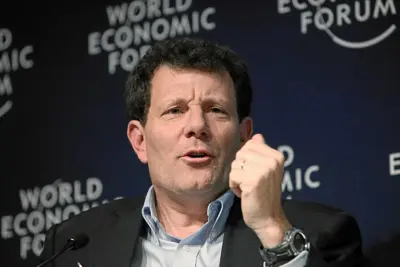
Nicholas Donabet Kristof is an American journalist and political commentator. A winner of two Pulitzer Prizes, he is a regular CNN contributor and has written an op-ed column for The New York Times since November 2001. Kristof is a self-described progressive. According to The Washington Post, Kristof "rewrote opinion journalism" with his emphasis on human rights abuses and social injustices, such as human trafficking and the Darfur conflict. Archbishop Desmond Tutu of South Africa has described Kristof as an "honorary African" for shining a spotlight on neglected conflicts.
