John Quincy Adams Quotes
America, in the assembly of nations, since her admission among them, has invariably, though often fruitlessly, held forth to them the hand of honest friendship, of equal freedom, of generous reciprocity. She has uniformly spoken among them, though often to heedless and often to disdainful ears, the language of equal liberty, of equal justice, and of equal rights. She has, in the lapse of nearly half a century, without a single exception, respected the independence of other nations while asserting and maintaining her own. She has abstained from interference in the concerns of others, even when conflict has been for principles to which she clings, as to the last vital drop that visits the heart …
At the time America was relatively weak militarily and a minor, but growing nation in the world. As the United States grew stronger, economically and militarily, foreign policy became more internationally oriented and assertive. 25 years after this speech, the United States invaded Mexico and ended up with what are now a few of our states. Abraham Lincoln and others objected and argued for the foreign policy of John Quincy Adams, but America began a new phase in foreign policy—one which markedly differed from that of the Founding Fathers and early Americans.
John Quincy Adams, 1767-1848, 6th President of the United States (Independent, MA), Address to U.S. House of Representatives, July 4, 1821
Sourced by: Eigen's Political and Historical Quotations


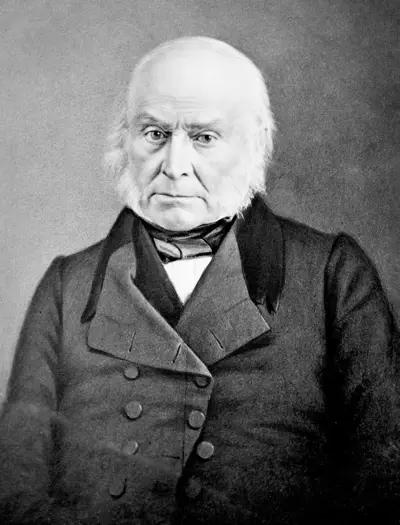
John Quincy Adams was an American statesman, diplomat, lawyer, and diarist who served as the sixth president of the United States, from 1825 to 1829. He previously served as the eighth United States Secretary of State from 1817 to 1825. During his long diplomatic and political career, Adams also served as an ambassador, and as a member of the United States Senate and House of Representatives representing Massachusetts. He was the eldest son of John Adams, who served as the second U.S. president from 1797 to 1801, and First Lady Abigail Adams. Initially a Federalist like his father, he won election to the presidency as a member of the Democratic-Republican Party, and in the mid-1830s became affiliated with the Whig Party.
