Gunnar Myrdal Quotes
America has had gifted conservative statesmen. But, with few exceptions, only the liberals have gone down in history as national heroes.
Gunnar Myrdal, Swedish Diplomat and Author, Quoted in Forbes, June 2, 1997
Sourced by: Eigen's Political and Historical Quotations

Actually, there have been “paranoid” fear of opposition political viewpoints in America very often. In the early days of the Republic, the Federalists main concern was not England or other foreign enemies, but Jefferson’s Democratic Republicans. And those Jeffersonians were absolutely convinced that the greatest danger to America was the Federalists who would bring back a monarchy if they could. The Jacksonians triggered a similar polarization. The Civil War stemmed from this extreme. Even America’s most popular President, Franklin Delano Roosevelt, who was elected to 4 successive terms, was perceived as the major “enemy” of America along with his wife Eleanor and the other New Dealers.


What if you are a conservative in a liberal environment? Then what you are conserving is liberalism.
His reference was to his experience as an undergraduate at Dartmouth, which he and associates views as a liberal organization, while others viewed it as a conservative bastion of the establishment.

After JFK’s assassination, many of his appointees who were liberal Democrats, were concerned that LBJ was a Southern conservative and might not want to serve in a conservative administration. Johnson satisfied Heller and all of the other Kennedy appointees who he asked to stay on. Actually, Johnson was more liberal than JFK, and proved it during his Presidency.

Holman is commenting on the Harvey Weinstein scandal in which he is accused of multiple sexual assaults over 30 or more years and the lack of liberal and progressive outrage and passive acceptance of his behavior by large circles of people who knew.


So far as he was concerned, Republican moderates—his own party members—were liberals. Anyone who did not support the extreme Conservative agenda, was an enemy and a liberal. He and the Tea Party drove almost all the moderate Republicans out of the party.


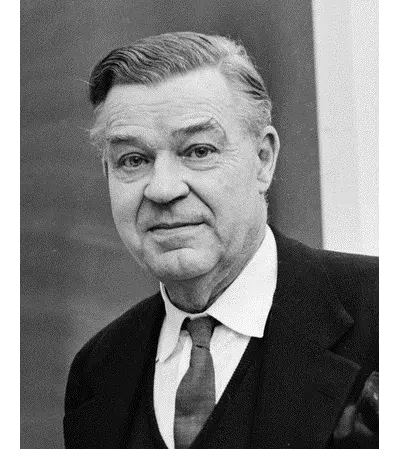
Karl Gunnar Myrdal was a Swedish economist and sociologist. In 1974, he received the Nobel Memorial Prize in Economic Sciences with Friedrich Hayek for "their pioneering work in the theory of money and economic fluctuations and for their penetrating analysis of the interdependence of economic, social and institutional phenomena." He is best known in the United States for his study of race relations, which culminated in his book An American Dilemma: The Negro Problem and Modern Democracy. The study was influential in the 1954 landmark U.S. Supreme Court Decision Brown v. Board of Education. In Sweden, his work and political influence were important to the establishment of the Folkhemmet and the welfare state.
