Ahmed Zewail Quotes
Although there exist in the world today some microbes of the soul, such as discrimination and aggression, science was and still is the core of progress for humanity and the continuity of civilization.
Zewail, Ahmed. Voyage Through Time: Walks of Life to the Nobel Prize. American University in Cairo Press, 2002.


This was a radical speech for the time, suggesting reforms that had been unthinkable to most Turks. Although it is not prohibited by the Koran and early Islamic artists made some of the greatest paintings and depictions of people, fundamentalists gained control of Islam and interpreted any statue as an idol that could be worshipped and this generalized to Islamic art in general where people ceased to be depicted and even animal depictions were rare. Muslim art developed incredible geometric intricacy but tended not to depict anything that is real. This extended to photography and illustrations in books including textbooks. At the same time, not unlike some Christian and Jewish Fundamentalists, the Muslim fundamentalists opposed science and the teaching thereof on the grounds that all authentic knowledge was in the Koran and anything else was not only false but also heretical. So this speech was a type of “declaration of war” against the established religious order and culture.


By symbols be was not only referring to metaphorical symbols of letters, words, digrams, numbers and formulas. The vast majority of all human knowledge is spread by symbols of one kind or another. The must sophisticated devices or weapons all boil down to sets of words, formulas and diagrams. Art is almost all symbolic.


This declaration, drafted by Russell and Einstein two days before Einstein’s death was signed by a number of other prominent scientists.


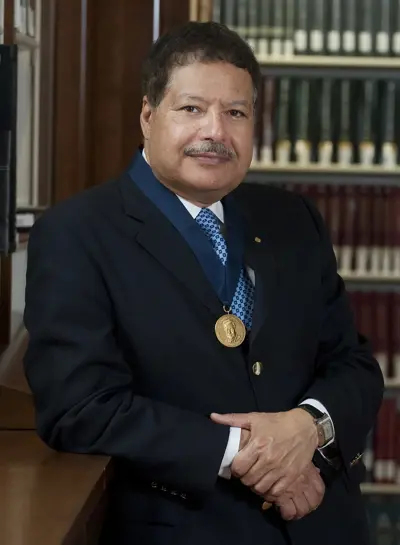
Ahmed Hassan Zewail was an Egyptian-American chemist, known as the "father of femtochemistry". He was awarded the 1999 Nobel Prize in Chemistry for his work on femtochemistry and became the first Egyptian to win a Nobel Prize in a scientific field. He was the Linus Pauling Chair Professor of Chemistry, Professor of Physics, and the director of the Physical Biology Center for Ultrafast Science and Technology at the California Institute of Technology.
