Benjamin Wittes Quotes
Al-Qaida is a cult of martyrdom.
Wittes, Benjamin. Law and the Long War: The Future of Justice in the Age of Terror. Penguin Press, 2008.


Some of the Prophet’s followers by modern standards were very violent and urged attacks on innocent people in order to intimidate others. He was expelled from his Egyptian university and arrested, tried and found guilty of “holding religion in contempt”. Which is a crime in most Islamic countries. He also “insulted” the President. He is the first blogger to have been jailed in Egypt for the contents of his blog. See {585058}.
See {586916} for a passage from the Koran supporting his point.
A Fatwa is an Islamic theological legal ruling. Islam has no hierarchy. So this Fatwa is not necessarily binding on any Muslims who do not wish to be bound by it. This is one of the relatively few Islamic theological organizations who have taken a public stand against terrorism.


“Martyrdom” is the euphemism that fundamentalist Muslims use to denote being killed while “fighting for Islam” or on a suicide mission for same. Many believe that such people ascend directly to Paradise where they are given a bevy of virgins and other “perks.” Ironically, this was the last interview that he gave before he himself was “martyred”—he was killed by coalition troops. This mental perspective is one of the reasons that fighting fundamentalist Islamic terrorists is so difficult. They perceive victory whichever way the battle or even the war comes out.


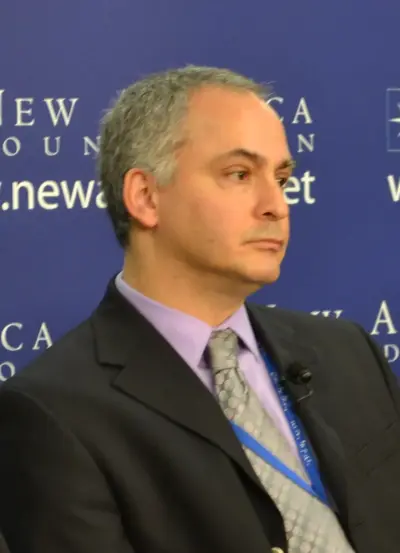
Benjamin Wittes is an American legal journalist and Senior Fellow in Governance Studies at the Brookings Institution, where he is the Research Director in Public Law, and Co-Director of the Harvard Law School–Brookings Project on Law and Security. He works principally on issues related to American law and national security. Along with Robert M. Chesney and Jack Goldsmith, Wittes cofounded the Lawfare Blog. Wittes is also a member of the Hoover Institution's Task Force on National Security and Law. Wittes is a frequent speaker on topics of detention, interrogation, and national security, before academic, government, policy, and military audiences. He also co-hosts the Rational Security podcast.
