Archibald Cary Coolidge Quotes
After the conflict had once begun, the vast majority of people involved, high and low, were convinced, as most of them still are, of the essential righteousness of their cause. This was not altered by the fact that four of the states bargained hard and long with both parties before casting in their lot with either. When they did act, they were as sure as anyone else that they were animated by the highest principles.
Archibald Cary Coolidge, 1866–1928, Historian, Political Scientist & Diplomat, Editor-in-chief of Foreign Affairs, Observation about WWI, “Ten Years of War and Peace”, Foreign Affairs, September 1923
Sourced by: Eigen's Political and Historical Quotations


This is an important quotation because it helps to dispel a myth that the Civil War was not about slavery. That was the reason that the rebelling states gave for secession, but apologists for the Confederacy have claimed that the average soldier on both sides did not care about slavery. (Two thirds of the Southern Soldiers came from families that did not own slaves; nonetheless it was clear that the main motivation of the Confederate Soldier was to protect the institution of slavery, while that of the Union soldiers was to destroy slavery.) Professor Manning found this in her book: What This Cruel War Was Over: Soldiers, Slavery, and the Civil War.


At that time the Israelis had been rebuffed after offing several major peace proposals and most were convinced that the Palestinians were so fractionated that no one would dare sign a peace even giving Palestinians their own state and sharing Jerusalem as the capital. So they just organized around security needs and walling Israel off from terrorist attacks while maintaining the occupation until something radially changes amongst the Palestinians. The Palestinians and the other Arabs did not want to negotiate either as they felt so weak that they believed they could never get decent terms, and they hoped for some military or terrorist victories where the Israelis would make large concessions to a strong opponent. At the same time there were a few ultra-orthodox Jews who did not want a peace and wanted to do what conquering nations had done throughout history—annex more conquered territory. There were a number of Arab groups, in addition to some Palestinians who did not want a peace at all, as for them there was no satisfactory solution so long as there was a Jewish state in their midst. See {632822} for more on the Israeli attitude then.


The report was from Heinrich von Tschirschky, the German ambassador to Austria-Hungary. He recommended that Germany persuade Austria-Hungary to not attack Serbia, not realizing the German leaders had already planned a war with Russia and saw the issues between the Austro-Hungarian Empire and Serbia was a good excuse to implement their war plans (see {642092}).


This quotation is surprising in that Mrs. Roosevelt was a leading liberal and one of the leading advocates for peace. This quotation might have been authored by a right wing conservative of the early 21st century.


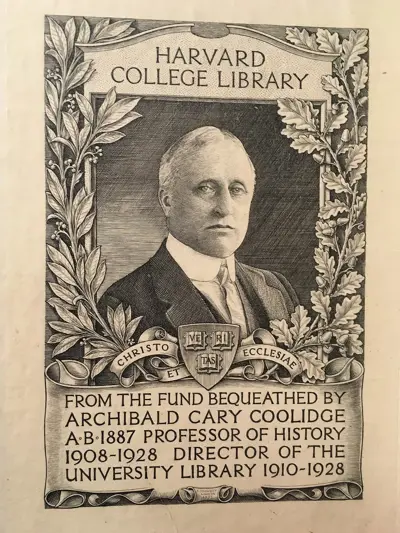
Archibald Cary Coolidge was an American educator and diplomat. He was a Professor of History at Harvard College from 1908 and the first Director of the Harvard University Library from 1910 until his death. Coolidge was also a scholar in international affairs, a planner of the Widener Library, a member of the United States Foreign Service, and editor-in-chief of the policy journal Foreign Affairs.
