Albert Camus Quotes
A régime [Nazism] which invented a biological foreign policy was obviously acting against its own best interests. But at least it obeyed its own particular logic.
Camus, Albert. The Rebel: An Essay on Man in Revolt. Translated by Anthony Bower, Vintage Books, 1991, p. 182.


This is a very important quotation. This was not the ravings of a right wing extremist. It was a normative view. This book was a best seller in Germany. This quotation illustrates the mentality of the conservative, militarist, culture that dominated Germany at the time. Racism was normative then in Germany. It was not the Nazis who introduced the concept of inferior races to Germany. Through this book and much before it, the idea was well established in aristocratic, militaristic culture. Also, note that the “inferior races” were considered a threat to civilization, not just inferior beings.

This book was the first popular attempt to spread the eugenics concept. Is was translated into German in 1925 and unfortunately read by Adolf Hitler who sent Grant a complimentary letter. See {603544} and {602054}
At the time there were some Americans who supported Hitler and Fascism. Even senior military men like Osborne.

The Germans were planning to use the 1936 Olympic Games in Berlin as a propaganda platform for their Nazi approach. Their perverse notion that the German Arayans were the most superior people and Blacks, Jews, Gypsies at the lower end of the spectrum was called into question by the fact that two of their own champions were Jewish. Goebbels gave orders that no newspaper could mention that fact. Mayer refused to participate. However the Nazi plan backfired when Jews and Blacks won many of the medals. Jessie Owens of America alone won 7 Olympic medals. Adolf Hitler, in order to avoid the “embarrassment” of shaking hands and congratulating Black and Jewish winners, refused to meet any of the athletes.

Charleston was in the Southern part of the state where most people supported slavery. Douglas made an unequivocal pitch for the racist vote {600060} and forced Lincoln to take a stand. Like many politicians today, Lincoln decided to give the audience what they wanted to hear. It is not clear whether or not he ever believed this statement or was just pandering in a political campaign. He had never said this in the Northern part of the state of before. Lincoln’s views on race changed and matured over the years, culminating in the Emancipation Proclamation. Lincoln lost the Senate seat to Douglas.
There had been vicious assaults on most of the Black workers, when a few Negro welders were hired. The “compromise” was that the Negro workers would be protected from harm but there would be no Blacks in skilled positions. This was despite a huge labor shortage and a critical national need for the ships in the midst of war. Patriotism and the national crisis could not overcome the racism and hatred that existed in America. Northern newspapers pointed out the irony that America was practicing and upholding the racial theories of Hitler and the Nazis.


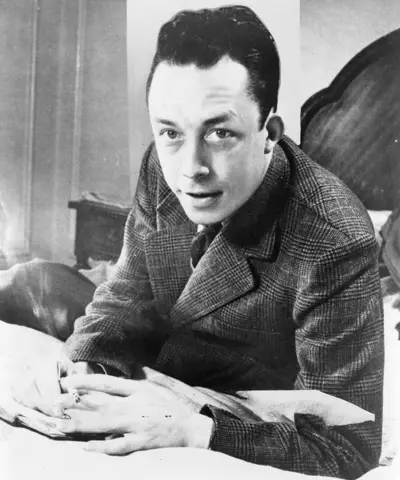
Albert Camus was a French philosopher, author, and journalist. He won the Nobel Prize in Literature at the age of 44 in 1957, the second-youngest recipient in history. His works include The Stranger, The Plague, The Myth of Sisyphus, The Fall, and The Rebel.
