Mahatma Gandhi Quotes
A policy is a temporary creed liable to be changed, but while it holds good it has got to be pursued with apostolic zeal.
Mohandas K. Gandhi, 1869-1948, Indian Political and Spiritual Leader, Letter to the General Secretary of the Indian Congress Party, March 8, 1922
Sourced by: Eigen's Political and Historical Quotations


Lev Davidovich Bronstein. Unfortunately, such party loyalty was not limited to the Communists. Excessive and unconditional party loyalty, and the extreme partisanship that goes with it, plagues many American politicians to the detriment of the country.


This is an interesting retrospective on slavery after the tragedy of the Civil War was recognized.


Politics is peculiar in the sense that most things are seen as black or white. In most other areas of human endeavor, people change, not because the old way was incorrect, but because the new way might be better. Einstein’s Theory of Relativity did not totally invalidate the physics of Issac Newton; it just improved on it in some areas.

While this is so in theory, both legislative and executive elected officials often abdicate their responsibility to set policy to the civil servants and Pentagon brass who write the regulations, and interpret the laws and Executive orders. In modern government, there are so many policies that need to be made that Congress and the President and Cabinet often don’t even know the issue exists much less what the national policy is. The Congress and President can choose to make specific policy on whatever they wish, but the Civil Servants as a de facto matter end up making the rest of the policy decisions. When there is Congressional gridlock, Congress can’t make very many policy decisions, so ironically, the civil servants and Pentagon brass make even more of the polices of the government.


The major idea of intelligence agencies in a democracy is for the intelligence agencies to provide the policy makers with facts on the ground and data with which they can make sounder policies. However, many times the policies of the administration is so firm that the political ideology restrict not only the kinds of analysis the intelligence agencies do, but in some cases shape or control the conclusions of otherwise sound studies. The influence of Vice President Cheney on the CIA and the invasion of Iraq.


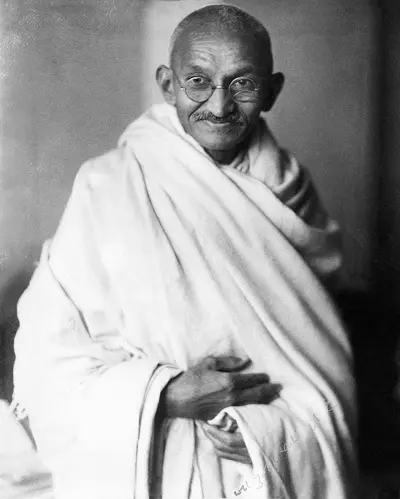
Mohandas Karamchand Gandhi was an Indian lawyer, anti-colonial nationalist, and political ethicist, who employed nonviolent resistance to lead the successful campaign for India's independence from British rule, and in turn inspired movements for civil rights and freedom across the world. The honorific Mahātmā (Sanskrit: "great-souled", "venerable"), first applied to him in 1914 in South Africa, is now used throughout the world.
