Woodrow Wilson Quotes
A nation is as great, and only as great, as her rank and file.
Wilson, Woodrow. "Address before the Southern Commercial Congress." 27 Oct. 1913. The Papers of Woodrow Wilson, edited by Arthur S. Link, vol. 28, Princeton University Press, 1978, p. 450.


During her adult life, she was the de facto ruler of China. This quotation is very important because it gives us an important insight into Chinese motives and historical drivers. The first reason is something almost all countries and cultures can identify with, but the second--to avoid being looked down—was just as important. Americans are relatively uncaring what the citizens of other countries think about them, but the Chinese do. So do other nationalities and cultures like the Arabs, the Iranians, many of the South American cultures. Often it takes on a different world like “dignity” or “respect”.


At that time Jews in Palestine were in the minority. The issue of how to obtain the land was hotly debated amongst Jewish groups. Jabotinsky was at one extreme—colonize and take the land just as the Arabs had done to the Jews when there was a Jewish majority. His view did not however prevail. The policy was to buy the land from individual Arabs and Jewish land up to 1948 was obtained that way. In that year the UN partitioned Palestine and 11 Arab armies attacked the new state of Israel and asked the Arab civilians to leave the area so that the Army could cleanse it of Jews. Many did not, and they or their descendants are still on their land or have sold it. The Arabs who left, were suspected of being possible collaborators or terrorists, and they have never been paid for their land or allowed to return. Compensation is still in dispute. At the same time Jews driven out of Arab countries by law and the military have never been compensated or given any right of return either.


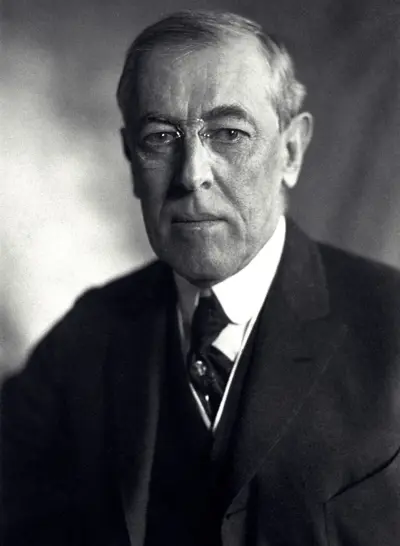
Thomas Woodrow Wilson was an American politician and academic who served as the 28th president of the United States from 1913 to 1921. A member of the Democratic Party, Wilson served as the president of Princeton University and as the 34th governor of New Jersey before winning the 1912 presidential election. As President, Wilson led the United States into World War I in 1917. He was the leading architect of the League of Nations, and his progressive stance on foreign policy came to be known as Wilsonianism. Scholars have generally ranked Wilson in the upper tier of U.S presidents, although he has been criticized for supporting racial segregation and white supremacy.
