Benito Mussolini Quotes
It is humiliating to remain with our hands folded while others write history. It matters little who wins. To make a people great it is necessary to send them to battle even if you have to kick them in the pants. That is what I shall do.
Benito Mussolini, 1883-1945, Italian Dictator, Remark to Galeazzo Ciano, April 11, 1940
Sourced by: Eigen's Political and Historical Quotations

He was leading the Gordon Highlanders of the British Army against the Boers during the Boer War. He was seriously wounded and could not go on himself with a charge he had ordered, However, waifing his sword he made this famous qutation. Particualrly noteorthy is the derrogatory terms which he used to describe the enemy--the Boers of South Africa. In many wars and cultures, one or more of the combatants, in order to overcome the avarage soldier's reluctance to kill an enemy, characterizes them as less than human. In this case, vermin, who were to be exterminated. There were two predominant groups of whites who came to South Africa, the English who were generally well-educated and were interested in trading with the exhisting inhabitants and investing in businesses using mostly native labot and the Boers. The latter were of Dutch and German origin, poor farmers with little or no land in the home country and little education. Their interest was to create a nation where they could own land to farm. And the lest expensive way for them to increase their farmland was to sieze it from the native Blacks and who were the major forces behind the racial discrimination which became apartheid. The British contolled the government and sought stability and as in most of the British Empire, they wanted English law to prevail including the rights of the Black natives. The Boers had left Europe for good and would thrive or not in Southern Africa. Proportiopnately, the English might have a career in South Africa or serve there for a few years. They were Englishmen in a foreign country. The Boers saw themselves as citizens of Southern Africa who were fighting the native Blacks for control of the land. The English legal system would not allow any of the land seizures and political discrimination that the Boers saw as existential for their survival in Africa. Soon, the Boers took more and more of the law into their own hands and saw English rule and dmination as inimical to their interests in Africa and they tried to create their own independent states in Southern Africa. That was the essense of the Boer Wars. Dick-Cunyngham was awarded the Victoria Cross, the highest military decoration of Great Britain, for his exploits in the Afghan War.


He had been urged to retreat

This line summarizes a principle of political leadership which demagogues understand intuitively and some other politicians learn. To galvanize or mobilize the public, set lofty, important objectives and goals and not small matters. Abraham Lincoln and Franklin Delano Roosevelt, two of our greatest Presidents, were able to do this very well. Other presidents and many politicians try this with minor issues that they think important and great, but they are often unsuccessful because only a small part of the population—the true believers—agree with the importance and greatness.

Ataturk was a young major at the time commanding troops of a weak and corrupt Ottoman regime. However a combined English and French (the strongest military powers in Europe) invasion of the Gallipoli Peninsula threatened to capture the Turkish capital, Constantinople. Ataturk alone rallied the Turkish defenders and fought the invaders to a standoff in long drawn out battle with huge casualties on both sides. Ataturk became a national hero. Although Ataturk thereafter was very reluctant to use military force or endanger troops, the thing he always thought worth the supreme sacrifice (including his own) was the independence and sovereignty of the nation. See {584502} for his continuing belief in this type of sacrifice.


This line was used in the WPA Federal Theater Project. The play was closed down, because the State Department was distressed that the Federal Theater quoting heads of State might be insulting to the world leaders. Mussolini was another character in the play and he was depicted as the boorish thug that he turned out to be. It was that which offended the government officials who closed the show before it could open. FDR used a similar line 6 years later. See {32529} . Dolores Ibarruri in the Spanish Civil War is quoted with a similar phrase at about the same time. See {604321}


A Federal Naval flotilla was preparing to attack South Carolina Forts Beauregard and Walker in the area of Hilton Head and Port Royal. The navy took both forts the next day with their naval bombardment so powerful that the Confederate Rebels had to abandon both forts gaining a kind of revenge for the Confederate capture of Fort Sumter at the war’s beginning.

Patton, one of the world’s best fighting general was somewhat mentally unbalanced and unlike almost all senior officers who are successful commanders but see war as an unpleasant, brutal necessity, Patton loved war and the fighting part of it. His non battlefield behavior was so erratic and atrocious that Eisenhower and his other superiors almost fired him on several occasions. He died in an automobile crash shortly after the German surrender, so the dilemma of what to do with Patton in peacetime was resolved.

On October 31, 1803, Tripolitan forces captured the ship Philadelphia and imprisoned the whole crew. The Pasha (provincial governor) of Tripoli, Yusef Karamanli demanded that the United States not only pay a ransom for the prisoners but an annual tribute to Tripoli.


Drumbo was morally opposed to war. He also refused to name Hollywood communists to Congressional Committees during the Red Scare. He was then blacklisted from his occupation, screen writing.

Attila the Hun. The Romans aided by Theodoric, King of the Visigoths, fought the Huns in the only battle that Attila ever lost which he lost badly. There were 165,000 men killed in an afternoon. The Roman General, Flavius Aetius, had been a boyhood friend of Attila’s and had fought with him against the Visigoths. The Romans had Attila trapped but his old friend let him escape with just a good thrashing to his ego and army as to not upset the balance of power and tilt it in favor of the Goths. Roman foreign policy at the time was to keep all the Barbarians strong enough to fight one another so that none would be dominant but all weaker than Rome. Divide and conquer.

He drove the British into the sea when no one expected that outcome.

In a massive terror campaign captured Republican males were shot and the Republican women were raped as a matter of the General’s policy. He would commonly broadcast—see {592113}—what had and would happen to Republicans who remained loyal to the government and continued to fight. It was the actions of men like this that led to the modifications of the Geneva Conventions.


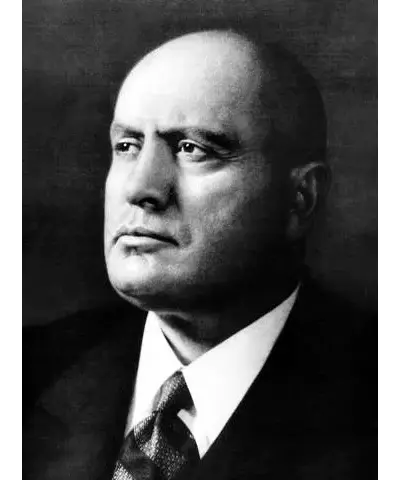
Benito Amilcare Andrea Mussolini was an Italian politician and journalist who founded and led the National Fascist Party. He was Prime Minister of Italy from the Fascist coup d'état in 1922 until his deposition in 1943, and Duce ("Leader") of Italian Fascism from the establishment of the Italian Fasces of Combat in 1919 until his execution in 1945 during the Italian Civil War. As dictator of Italy and founder of the fascist movement, Mussolini inspired other far right rulers such as Adolf Hitler, Francisco Franco, and António de Oliveira Salazar.
