Marcus Tullius Cicero Quotes
A nation can survive its fools, and even the ambitious. But it cannot survive treason from within. An enemy at the gates is less formidable, for he is known and carries his banner openly. But the traitor moves amongst those within the gate freely, his sly whispers rustling through all the alleys, heard in the very halls of government itself.

On the BBC during World War II:


Before the 1968 election, President Johnson, and gotten the North Vietnam Communists to agree to Peace Talks with the U. S. and South Vietnam. Then Candidate Nixon thought that if the peace talks were ongoing and making progress, there would be more support for the Democrats and Nixon's opponent Hubert Humphrey. So Nixon secretly send a secret emissary to South Vietnamese President Nguyen Van Thieu telling him that he would not get a very good deal because President Nixon claimed that President Johnson was too eager to end the Vietnam war. He suggested that if Thieu boycotted the peace talks, then when Nixon was elected, he would guarantee a much better deal for South Vietnam and Thieu personally. President Thieu boycotted the peace talks and there could be no progress. However there is a Federal Law, the Logan Act, that makes it a felony for a private American citizen to conduct or interfere with foreign policy or negotiations with a foreign government. President Johnson found out about Nixon—s sabotage of the Peace Talks, called Nixon and threatened him with prosecution if he interfered further. LBJ had decided that with the left wing at odds with the U. S. Government over the Vietnam War, a prosecution of Nixon would cause the Right Wing to challenge the government also and the country didn—t need further polarization. He would do that only if Nixon did not heed the President—s warning. But when Nixon won the election and became President, he was terribly anxious that his pre-election crimes would be made public, and spent much of his time and staff effort trying to find out who knew about his politically self-serving felony and who might make his crime public. See {583264}.


In 1937 four nationalist army columns were converging on Madrid in the Spanish Civil War. General Mola was asked which column would take Madrid. His reference to the sympathizers inside the city became a universal term for traitors.

Harrison, then a young Captain, was concerned about the French, British and Spanish agents "plotting" in the United States:


Traitors and spies were their terms for Southern sympathizers in the Federal Government. Many of these would pass information to the rebels.

Commenting on a former CIA agent's defection to Russia:

The confusion of dissent and dissidence and loyalty has plagued many political parties and nations throughout time. The Communists neither originated the concept and certainly were not the last to operate by it, but under Stalin, it took on a virulence that was later emulated by the American McCarthyism.


McCarthy was one of the most interesting political phenomena of politics in the 1950s. He was an alcoholic megalomaniac who made wild accusations about communists everywhere and that the Secretary of State and other politicians were communists. He claimed to have a list of thousands of communists in high positions of government. His accusations were so dramatic that most people assumed that there were facts behind them otherwise no rational man would say such things. But it turned out that not a single accusation was ever proven. When McCarthy was esposed, he was censured by the Senate and he lost most of his political credibility and shortly thereafter died as a result of his severe alcoholism.


Bush had served earlier as the head of the CIA and understood the costs of such better than most. He was put in a difficult position when his son was President and one of the senior White House operatives, for small partisan advantage, leaked the name and identity of Valerie Plame, a covert CIA operative. Bush the father, remained silent even after the leaker was identified.


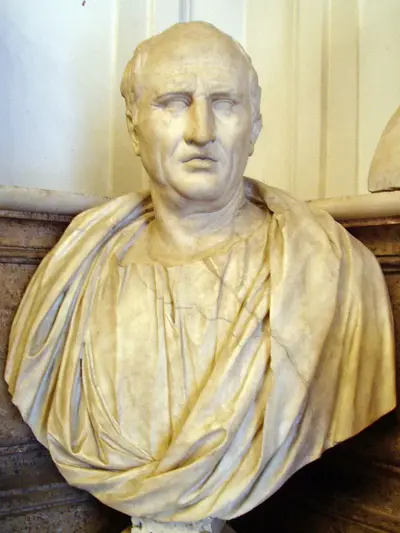
Marcus Tullius Cicero was a Roman statesman, orator, lawyer and philosopher, who served as consul in the year 63 BC. He came from a wealthy municipal family of the Roman equestrian order, and is considered one of Rome's greatest orators and prose stylists.
