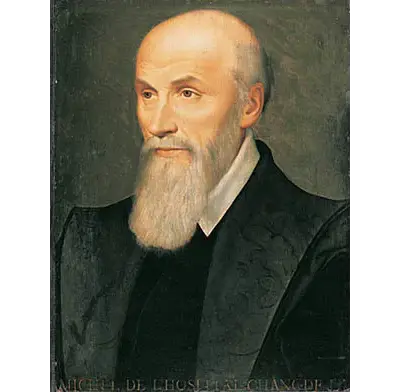
Michel de L'Hopital Quotes
A man does not cease to be a citizen for being excommunicated.
This amazing pronouncement separated the right of citizenship from religion. This was opposed by most clerics as to them excommunication meant that the person should have no rights whatsoever. There was a practical side to the Chancellor’s view. At the time there were bitter religious civil wars in France. Each sect would castigate and excommunicate its religious and often military enemies. Things had reached such a point where anybody who was anybody had been excommunicated by somebody. If citizenship were to be nullified by excommunication, then the state would have to take sides. If it treated all excommunications as equal, too many people would be denied their citizenship. Therefore the only practical solutions were to have a single state religion or to separate excommunication from citizenship. France was beyond the possibility of a state religion with Catholics, Lutherans, Huguenots--all had large established congregations of followers and there were smaller sects.
Michel de L'Hopital, 1504-1573, Judge, Scholar and Chancellor of France, Address to the Estates assembled at Orleans, December, 1560
Sourced by: Eigen's Political and Historical Quotations

As enlightened as this statement is, it was not always a part of Mormon doctrine. When Brigham Young was head of the church he also served as Governor of the Utah Territory, and the separation of church and state was not so clear. In modern times however, the Mormon views have been the quintessential views of most Americans—Mormon or otherwise.

Lopez had come from Portugal and had been living in Rhode Island for 9 years and was active in shipping, whaling and candle making. He, and another Jew, Issac Elizer, petitioned the Rhode Island Superior Court for naturalization and citizenship rights. The court turned them down and they appealed to the Rhode Island Assembly—then not only the legislature but the highest court in the colony. The assembly came up with a compromise. The Jews were allowed to continue to live and work in Rhode Island but they could not hold public office or vote. They told the Superior Court to reconsider the case however as Lopez and Elizer were model citizens—but for religion just the kind the colony wanted. This case and many others were known to the founding fathers who were determined to put a stop to the practice of conditioning voting and office holding rights on adhering to the particular sect of the majority of the colony. Lopez and Elizer then appealed again to the Superior Court.

Bush was trying to obtain the Republican Presidential Nomination and that party had come under the influence of Protestant Evangelicals who could in effect veto any candidate in the Primary election. Bush, who was already suspect with the Evangelicals, chose to make this statement with the full knowledge that there is no Constitutional citizenship requirement to believe in a god and that a number of the leading founding patriots and founders had been atheists. However his tactics were successful and the following year he was the Republican nominee. Despite this statement, he never acted on it or made it a part of his administration’s principles. Politicians are often placed in these difficult positions where they are pressured into positions not to their liking in order to politically succeed. In this case, he never did more than make the disgraceful statement. He did not adopt any policy of take any action. However, this quotation is unique in American history as the only time an American president ever stated that American citizenship should not be recognized for religious reasons only.

The origins of the extreme religious intolerance of Spain occurred centuries before the excesses of the Spanish Inquisition. Before the Conference the Visigoths and their king had been converted to Christianity but not all cared for the new religion.

It took only 10 days after the First Continental Congress met for religious bigotry to arise. After hundreds of years of Catholic/Protestant strife, each sect looked upon the other, not only as theologically wrong, but dangerous to the liberty of the other. Unfortunately, the organied religions had acted so badly towards other religions, that everyone was justified in fearing the other religions. This quotation illustrates a then typical attitude of many American Protestants that the Catholic Church was a threat to national security. Ironically, in modern times, anti-Catholic bigots use this quotation to demonstrate that the United States was founded as a Christian Protestant nation—not a general Christian nation. A small, vicious anti-Catholic sentiment still exists, usually by a minority of right wing Protestant religious fundamentalists. Protestant England had just repealed the laws making Catholicism illegal, but this was regarded at that time as intolerable for the new America. This was one of the disputes which that the Founding Fathers were faced with later and one of the reasons that they were so absolute in the need for the 1st Amendment.

He had been a Congressman before assuming the Presidency. Civil rights was a major subject of debate after the Civil War. One major issue was that of citizenship itself. Many contended that Americans were citizens of a state and dependant on the state for the protection of civil rights. However, the extent to which the Federal government could and should be the guarantor of citizenship issues was in dispute. Today with the issue settled in favor of Federal preeminence, it is hard to realize that this was very unsettled at one point in history. Garfield was one of those leading the effort for more Federal involvement and control.

As a woman, Anthony was found guilty of “illegal voting” in the Presidential election of 1872. Fining her $100 the judge asked if she had anything to say. This was her reply.


Louisiana was then a possession of France
Lopez and Elizer were Jews who had escaped the persecution in Portugal to come to America. They and other non-Christians could live and work in Rhode Island but could not vote or hold public office by a previous decision of the Rhode Island Assembly. See {619707}.The Jews had petitioned for their civil rights.

There was freedom of religion for Protestants in early New Jersey. Note that Catholics and Jews were not allowed to hold office. This constitution was in force until 1844 when the prohibition was repealed by new constitution. Under the original constitution, men were convicted for blasphemy. See {621063} .

See {619709}. Ever since the Jews were ejected from their nation by the Romans, there have been some Jews and non-Jews who believed that the refusal of other nations to allow Jews citizenship inhibited their assimilation and was God’s way of maintaining the Jews as a distinct people so that they may fulfill Biblical prophesy and return to the Land of Israel. Stiles was a leading historian of his day and specialized in ancient Biblical history. Most people however, and most Jews, do not hold with this theory.

After attending a Lincoln speech, Booth said to Lewis Powell, one of his band of conspirators, “Now, by God, I’ll put him through. That is the last speech he will ever make.”


Porush was one of the Haradi--ultra-orthodox Jews. In the land of the Jewish people, he argued against religious freedom for Jews unless they were Orthodox Jews, while ironically, the majority of Jews in the world and even in Israel followed the Conservative or Reform branches of Judaism or were secular. At the time the Orthodox Jewish movement was the only one that was recognized officially by the government. Porush and some of the more fanatical Haradi were determined to keep the Conservative and Reform Jewish branches unrecognized and unsupported by the government. (Israel does not have separation of church and state and economically supports the Orthodox Jewish establishment but not the other majority branches of Judaism.) The "Women of the Wall" is one of the major groups in Israel advocating equal government treatment for all citizens o0f Israel. Orthodox Judaism, like many other orthodox religions are very sexist and women were actually banned from praying at the holiest of Jewish places, the Western or Wailing Wall. Women of the Wall had won a major decision of the Israeli Supreme court that women could not be denied the right to pray at the Wall. The orthodox rabbis who the government allowed to control access to the Wall, set aside a small area for women at the "Dung Gate" where the garbage was carried out. Women of the Wall were back in court and this prompted Porush's outburst. He was cebsured by the Ethics Committee of the Israeli Knesset (Parliament).


The call for individual liberty and the right of personal property by clergy is surprising to many. This Cahier was the consensus of the Clergy of Blois in 1789. There were cahiers of several provinces of France—some by the clergy, some by the nobles. What is fascinating is the emergence of many of the pre-Revolutionary French concepts. The example of the American revolution and its principles was known throughout the educated classes of France.

Curtis resigned from the court over the majority opinion.


Religious organizations may become grantees or contractors to perform various social services—along with other non-profit organizations provided, that they do not comingle the government contract money with the general church funds, that the services that are provided are provided to all regardless of religious beliefs, and that there is no religious ceremony or indoctrination in the provision of services. Catholic Charities and the Salvation Army are two of the larger religious organizations that receive government funds for general service provision. Those religions who do not want Federal Auditors reviewing their use of the money or who insist that prayer is a necessary aspect of the social services are the ones who have trouble and accuse the government of being hostile to religious social services.


Roman citizenship had been reserved only for Romans. However, when Caesar spend extended time in Cleopatra’s Alexandria, he saw the effect of having a great center of learning in a city. It not only improved the quality of life, but the economic effect was profound as even though Rome was the most powerful Empire of the world, Alexandria was much larger, wealthier, and better developed. It was an effect not unlike that of a great university made throughout Europe later and America today. The scholars and intellectuals in sufficient numbers acted like a modern incubator.

The 14th Amendment made the Black slaves and their families all citizens as most people know, but it had two other important aspects. It prohibited the individual states from deciding who who was and was not a citizen of the country and the state. In addition, it guaranteed that anyone born in the United States was a citizen regardless of the status of his parents—citizens or not, illegal immigrants or legal.