Reinhold Niebuhr Quotes
A democracy cannot of course engage in an explicit preventive war. I lament the inability to comprehend the depth of evil to which individuals and communities may sink, particularly when they try to play the role of God to history.
What Niebuhr assumed as the belief of all politicians in democracies, and was since the founding of America, was suddenly questioned and changed by President George W. Bush in his attack on Iraq to preempt the use of weapons of mass destruction. In the War on Terror, many Americans reconsidered this fundamental principle.
Reinhold Niebuhr, 1892-1971, Theologian, Quoted in Arthur Schlesinger Jr., Forgetting Reinhold Niebuhr, New York Times Book Review, September 18, 2005
Sourced by: Eigen's Political and Historical Quotations

The veracity depends on how one defines a democracy. Serbia attacked Croatia and Bosnia—all fledgling democracies. Argentina, claiming to be a democracy, attacked England by invading the Falkland Islands. Hitler was elected in Germany in a free and fair election, and once they started their aggressive war Germany became a Fascist Dictatorship. What appears to be the case is that stable industrial democracies never make war on each other.

During the Irish Potato the official who was in charge of the relief program was a highly religious, fundamentalist Christian who believed that the famine was God’s retribution.


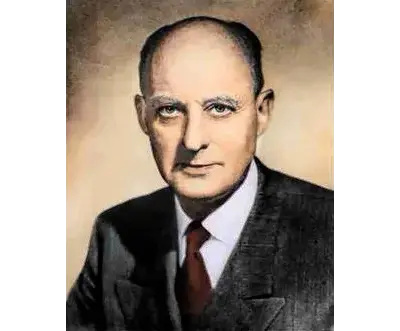
Karl Paul Reinhold Niebuhr (1892–1971) was an American Reformed theologian, ethicist, commentator on politics and public affairs, and professor at Union Theological Seminary for more than 30 years. Niebuhr was one of America's leading public intellectuals for several decades of the 20th century and received the Presidential Medal of Freedom in 1964. A public theologian, he wrote and spoke frequently about the intersection of religion, politics, and public policy, with his most influential books including Moral Man and Immoral Society and The Nature and Destiny of Man. The latter is ranked number 18 of the top 100 non-fiction books of the twentieth century by Modern Library. Andrew Bacevich labelled Niebuhr's book The Irony of American History "the most important book ever written on U.S. foreign policy." The historian Arthur Schlesinger Jr. described Niebuhr as "the most influential American theologian of the 20th century" and Time posthumously called Niebuhr "the greatest Protestant theologian in America since Jonathan Edwards."
