Herodotus Quotes
A Cadmean victory
A Cadmean victory has come to mean a victory in which the victor suffers as much as the loser.
Herodotus, c. 480-425 BC, Greek "Father of History", History of the Persian Wars, I
Sourced by: Eigen's Political and Historical Quotations


Up Front was a book of cartoons with his two GI characters, Willie and Joe. The quote is from their dialogue. Up Front which won the Pulitzer Prize.


This was the philosophy of the Israeli Defense Forces of the 20th Century, and became fundamental to the American military with its cultivation, training and use of special, elite forces.
This was a precursor of the total war views of William Tecumseh Sherman and Ulysses S. Grant during the American Civil War half a century later.

Very few societies ever had the wealth accumulated so that they could afford prolonged military operations. In addition, long, prolonged conflicts erode morale, both civilian and military. The Afghanistan War that went on for over a decade caused both and put a great strain on the U. S. national budget.

Each day the German Airforce was sending air assaults over England. The English defenders were shooting down 2 Germans for every English plane lost. The British however were running out of pilots. Both sides were terribly weakened. However it was the Germans who cracked and called off the air assault prelude to the planned invasion of England.


The Virginia Campaign of May 1864 was clearly the beginning of the end of the war. This was clear at the time, not only to the military leaders of both sides, but also to the media and thence the general public in the North. At the beginning of the war the Army of the Potomac, the largest Union Army was commanded by McClellan whose concerns were with his own political career and not winning the war. He had an aversion to heavy fighting and did not see the war strategically as Lincoln, Grant and Sherman did: To cripple the capacity of the South to wage war. So the early history of the Army of the Potomac was a series of undecisive battles which were either standoffs or the Confederates won despite the much larger and better armed and equipped Union army. As soon as McClellan was replaced, things began to turn around and when Grant was selected for Command of all Union Troops, the Army of the Potomac performed much better, including taking Richmond, the Confederate Capital.


The South could not replenish their lost arms and munitions nor could they replace most of the men wounded, killed or taken prisoner. The Union could do both. Therefore as long as the Union army inflicted casualties, it mattered little who won which battle as long as the fighting was in the South. This critical strategic reality was never appreciated by the Union Generals who were generally reluctant to take large casualties. When Grant and Sherman finally were able to set the strategy of attrition in operation, the Union actually won most of the battles though he and Grant took very high casualties. The casualties of the Confederates were generally higher but they did not have to be for the Union to win. The Civil War was a strategic form of suicide. Ironically, at a few points the rebellion might have succeeded because of the incompetent and timid Union military leadership at the beginning of the war.
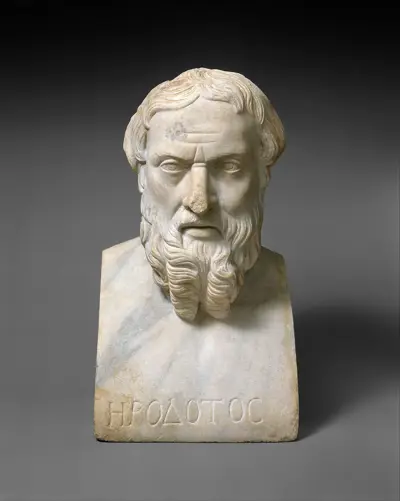
Herodotus (/hɪˈrɒdətəs/; Ancient Greek: Ἡρόδοτος, Hēródotos, Attic Greek pronunciation: [hɛː.ró.do.tos]; c. 484 – c. 425 BC) was an ancient Greek historian who was born in Halicarnassus in the Persian Empire (modern-day Bodrum, Turkey). He is known for having written the book The Histories (Ancient Greek: Ἱστορίαι Historíai), a detailed record of his "inquiry" (Ancient Greek: ἱστορία historía) on the origins of the Greco-Persian Wars. He is widely considered to have been the first writer to have treated historical subjects using a method of systematic investigation specifically, by collecting his materials and then critically arranging them into a historiographic narrative. On account of this, he is often referred to as "The Father of History," a title first conferred on him by the first-century BC Roman orator Cicero.
