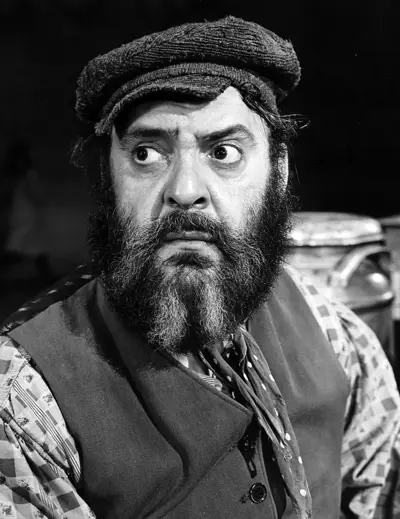
Zero Mostel Quotes
18th Century Fox
The actor and many others refused to cooperate with the House Un-American Activities Committee investigations into alleged communist activity and was blacklisted by the move industry for over a decade. See {588759} and {588760}.
Zero Mostel, 1915-1977, Actor, Derogatory name for the 20th Century Fox Movie Studio
Sourced by: Eigen's Political and Historical Quotations
The actor refused to cooperate with the House UnAmerican Activities Committee investigations into alleged communist activity. The actor refused to cooperate with the House Un-American Activities Committee investigations into alleged communist activity and was blacklisted by the move industry for over a decade. See {588677} and {588760}.
The actor refused to cooperate with the House Un-American Activities Committee investigations into alleged communist activity and was blacklisted by the move industry for over a decade. See {588677} and {588759}.
The Red Scare had affected much of the country. The House Un-American Activities Committee had frightened much of the country claiming that the Communists had infiltrated the government. But when facts and proof were demanded, all they came up with some workers in the Hollywood film industry who had gone to communist meetings and some who had joined the party before the War when The Great Depression was still plaguing the country. The Hollywood and TV executives caved in to the political demagogues and fired and blacklisted not only the communists but those who refused to testify. The actors and musicians could not work for several years until the country came to its senses, but the screenwriters wrote under false names. At least one Academy award was won that way.
The film won 7 Academy Awards including Best Picture. However, the Political Red Scare, Congressional Investigations, McCarthyism, and Hollywood Blacklist intimidated the Movie Studios and executives to avoid anything that was sympathetic to any reform views that the Communists also held, like anti racial discrimination, and empathy for the poor.
The Red Scare had affected the country. The House Un-American Activities Committee had frightened much of the country claiming that the Communists had infiltrated the government. But when facts and proof were demanded, they only came up with some workers in the Hollywood film industry who had gone to communist meetings and some who had joined the party before the War when The Great Depression was still plaguing the country. The Hollywood and TV executives caved in to the political demagogues and fired and blacklisted not only the communists but those who refused to testify. The actors and musicians could not work for several years until the country came to its senses, but the screenwriters wrote under false names. At least one Academy award was won that way.
Seeger had been a member of the Communist Party and had left it in 1950. See {635866}. He was later called before the House UnAmerican Activities Committee and asked to reveal the names of others who had been members. In those days of the red scare and McCarthyism, most people asked to name names and not wanting to do so “took the 5th Amendment” and could not be legally forced to reveal the names. Seeger as a matter of principle refused to plead the 5th Amendment because he was not afraid of incriminating himself and had done nothing criminal anyway. So he, a war veteran of WWII, instead refused to answer citing his First Amendment right of freedom of association. There was no legal precedent for this, and he was indicted and convicted for Contempt of Congress. However, his conviction was overturned as unconstitutional by the U. S. Federal Appeals court. Seeger had prevailed legally. But in retaliation Seeger was blacklisted and none of the radio of TV networks or Hollywood Studios would allow him (and other blacklisted artists) to appear. See {642545} Today most Americans view what McCarthy, The Congressional Committee, the networks, and Hollywood studios had done as contemptible.
Americans had never had the opportunity to see this committee in action before. While many Americans were intimidated, many were also very distressed to see how a Congressional Committee was abusing its power. And although the frightened Hollywood and network executive executives were intimidated into blacklisting Lawson and others, more and more Americans were lining up against this committee and Senator McCarthy’s committee in the Senate. This culminated in the Senate sanction of McCarthy and the discrediting of HUAC which never again had the influence that they had before this hearing.
- Born: February 28, 1915
- Died: September 8, 1977
- Nationality:
- Profession: Actor, Comedian, Singer
Samuel Joel "Zero" Mostel was an American actor, comedian, and singer. He is best known for his portrayal of comic characters such as Tevye on stage in Fiddler on the Roof, Pseudolus on stage and on screen in A Funny Thing Happened on the Way to the Forum, and Max Bialystock in the original film version of Mel Brooks' The Producers (1967). Mostel was a student of Don Richardson, and he used an acting technique based on muscle memory. He was blacklisted during the 1950s; his testimony before the House Un-American Activities Committee was well publicized. Mostel later starred in the Hollywood Blacklist drama film The Front (1976) alongside Woody Allen, for which Mostel was nominated for the British Academy Film Award for Best Supporting Actor.