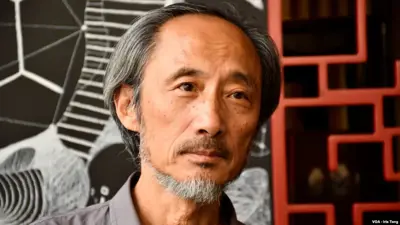
After the Tiananmen Massacre, I felt compelled not only to continue writing but to actively resist the restrictions placed on freedom of speech. I set up the publishing company in Hong Kong, with offices in Shenzhen in mainland China, and managed to publish works of fiction, philosophy, and politics by unapproved authors.
The Chinese have made a faustian pact with the government, agreeing to forsake demands for political and intellectual freedom in exchange for more material comfort. They live prosperous lives in which any expression of pain is forbidden.
To become self-aware, people must be allowed to hear a plurality of opinions and then make up their own minds. They must be allowed to say, write and publish whatever they want. Freedom of expression is the most basic, but fundamental, right. Without it, human beings are reduced to automatons.
I wanted to analyse and understand how the Chinese people could have their lives so crushed by fear.
The Chinese people have been forced to forget the Tiananmen massacre. There has been no public debate about the event, no official apology. The media aren't allowed to mention it. Still today people are being persecuted and imprisoned for disseminating information about it.
In 1989, I was on Tiananmen Square with the students, living in their makeshift tents and joining their jubilant singing of the Internationale. In the two decades since, each time that I have gone back, visions from those days seem to return with increasing persistence.
I believe that the Tibetans should have the right to control their own destinies and decide for themselves whether they want to be part of China or not. But this view isn't shared by most Chinese, or even the leaders of most Western democracies. As long as the Communist Party is in power, there is little hope for Tibet.
Red Dust was about the late 1980s; it was a time of burgeoning hopes and opening up and people searching for new ways.
I left Beijing in the late 1980s to live in Hong Kong because, having been blacklisted by the government, I couldn't publish my works on the mainland.
In February of this year I returned to China to research my next book. The authorities know about the novels of mine that have been published in the west, including the latest one, Beijing Coma, about a student shot in Tiananmen Square, but so far have allowed me to return.
Beijing Coma took me 10 years to finish.
I am completely in favour of dialogue and engagement. But it must be a true, open dialogue.
When history is erased, people's moral values are also erased.
If you exile a writer, however free the country he is sent to, there will always be a sense of internal constraint.
The Beijing Olympics represent China's grand entrance onto the world stage and confirmation of its new superpower status.
When people are poor, they find ways of making things taste like fish.
'Three Kingdoms' gives you a panoply of different routes; everyone can find their own path. It shows that sometimes the route to fulfilment or success is not the obvious one. You must take twists and turns to achieve a goal.
Whatever China I'd been born into, I would probably still have become a painter - I loved sketching portraits as a child, and began art classes at the age 7. But if China hadn't been under Maoist rule, I might never have become a writer.
I meant that the Chinese people are not aware of their own entrapment. They believe they live in a free society, but don't realize how much they are being monitored and controlled, how much the information they receive is restricted and warped, until they step out of line, that is, and feel the heavy hand of the state fall on them.
I left Beijing in 1987, shortly before my books were banned there, but have returned continually.
Living in London is like being on a luxury cruise liner.
I have to live within my memories, within my private universe, and continually return to China, the land where my thoughts are locked. This is a very painful kind of existence, this feeling of nowhereness.
I am a writer. Being critical is a writer's responsibility.
Tyrannies not only want to control your mind and thoughts but your flesh as well.
When the written and spoken word is censored, the urban landscape becomes a nation's only physical link to the past.
It is vitally important for me, both personally and for my writing, to be able to return to China freely, so being barred entry has caused me deep concern and distress.
While I was writing 'Stick Out Your Tongue' in Beijing, the police began knocking on my door again. As soon as I finished the book, I moved to Hong Kong so that I could work undisturbed on my next novel.
China is completely lacking in self-awareness and as someone who has stepped outside that society, I have a responsibility to write about it as I see it.
In my 20s, when I was a photojournalist in Beijing. I joined an underground art group and put on clandestine exhibitions of my paintings.
Ma Jian is a Chinese-born British writer.