Richard P. Feynman Quotes
You should not fool the laymen when you're talking as a scientist... . I'm talking about a specific, extra type of integrity that is not lying, but bending over backwards to show how you're maybe wrong, [an integrity] that you ought to have when acting as a scientist. And this is our responsibility as scientists, certainly to other scientists, and I think to laymen.
Feynman, Richard P. Surely You're Joking, Mr. Feynman!. W. W. Norton & Company, 1985, p. 343.


He was very aware that there were three factors inhibiting staff members from speaking up to criticize a plan: Junior officers a reluctant to take a position that is in opposition to their superiors; many attendees see themselves as institutional representatives of their organization or sub organization and are reluctant to take a position different from that which was taken by the organization; after months of planning and the vast majority of other staff in support of a plan, most people are intimidated from raising a dissident point of view especially if they are the only one in the group with that view. Presidents, agency heads, commanders, and other leaders all face this problem. However many do not want any dissident opinions at the late stages of a planning process. The better leaders however do want those outlier opinions especially at the later stages. Eisenhower usually went out of his way to emphasize his desire for honest criticism and chided others who did not like criticism—see {637081} ,

That was the position that candidates from both parties took as judged from their reactions to the other leaving out important information. While to most Americans, this is lying, it has become a political norm with the exception of a few politicians.


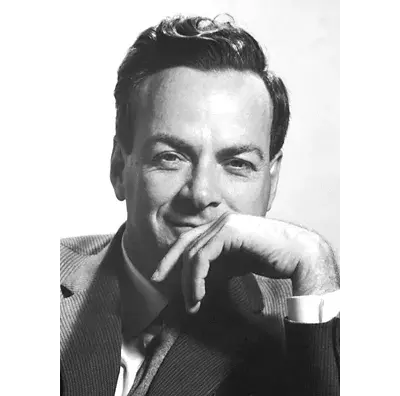
Richard Phillips Feynman was an American theoretical physicist and Nobel Prize winner who made significant contributions to quantum mechanics, quantum electrodynamics, and particle physics. He's known for his work on the Manhattan Project, developing Feynman diagrams, and explaining the interactions between light and matter. While studying for his PhD, Feynman participated in the Manhattan Project and helped develop the atomic bomb. For contributions to the development of quantum electrodynamics, Feynman received the Nobel Prize in Physics in 1965 jointly with Julian Schwinger and Shin'ichirō Tomonaga.
