Charles de Gaulle Quotes
You have a solid State behind you, a united nation, a great army. For my part, I am too poor to afford bending.
Winston Churchill had suggested that the French President should not be so rigid in his negotiations with FDR and the Americans.
Charles De Gaulle, 1890-1970, French President, Remark to Winston Churchill, Quoted in Jean Lacoulture, De Gaulle: The Rebel, 1990
Sourced by: Eigen's Political and Historical Quotations


In Pakistan, the civilian governments were not in control of the army who would have their own polices, foreign and domestic. When the head of the Army assumed the Presidency in a coup, he approached the Prime Minister of India—the Pakistan traditional enemy—and assured him that unlike with the civilian governments, he could negotiate for the country. Ironically, Prime Minister Manmohan Singh disclosed this quotation after Pervez Musharraf was deposed and democracy and civilian government returned to Pakistan. However the Indian Prime Minister then complained that there was no one to negotiate with as the civilian elected prime minister could not speak for the army—still the major power in Pakistan.


Each of the Dutch provinces and towns was relatively independent with no central or federal government that could organize or bring consistency to Holland. Each city and community had their own military with no common command, training, logistics, weapons or other common elements that the times began to require. The representatives from Rotterdam made this public declaration for a unified—federal—government.


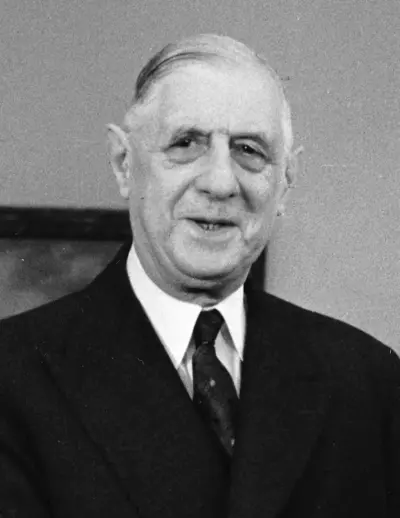
Charles André Joseph Marie de Gaulle was a French army officer and statesman who led Free France against Nazi Germany in World War II and chaired the Provisional Government of the French Republic from 1944 to 1946 in order to reestablish democracy in France. In 1958, he came out of retirement when appointed President of the Council of Ministers (Prime Minister) by President René Coty. He rewrote the Constitution of France and founded the Fifth Republic after approval by referendum. He was elected President of France later that year, a position to which he was reelected in 1965 and held until his resignation in 1969.
