Thomas Paine Quotes
Ye that dare oppose, not only tyranny, but the tyrant, stand forth!
Paine, Thomas. Common Sense; Addressed to the Inhabitants of America. R. Bell, 1776, p. 60.


Franklin Delano Roosevelt used the phrase in his Third Inaugural Address {32529}. But the earliest expression that we have found is the Mexican leader Emiliano Zapata {46999} Franklin Delano Roosevelt later used the phrase in his Third Inaugural Address {32529}. But the earliest expression that we have found is the Mexican leader Emiliano Zapata {46999}. This was one of the great quotations to come out of the Spanish Revolution. It inspired freedom loving people the world over, then and through this day.


The “experts” were scientists and science educators who had testified that Creationism, a notion that some religious Christians believe is a more valid explanation of the development of plants and animals than is Evolution, is a religious belief, not a science and should not be taught in a science curriculum. McLeroy believed that even in teaching science, scientific thinking and expertise should not be given more weight than religion in general and Christianity in particular. Some fundamentalist Protestants find Evolution distressing in that it contradicts the literal Biblical narrative. Other Protestants, Jews, and Catholics do not see anything in Evolution that conflicts with their spiritual view of God. They see Evolution as the mechanism that God created for the development of life. McLeroy was defeated in the next election after taking this anti scientific position, and was replaced with another fundamentalist Protestant—but one who did not believe that a particular Protestent, Christian view of the world which scientists generally reject should be taught as science in public schools.


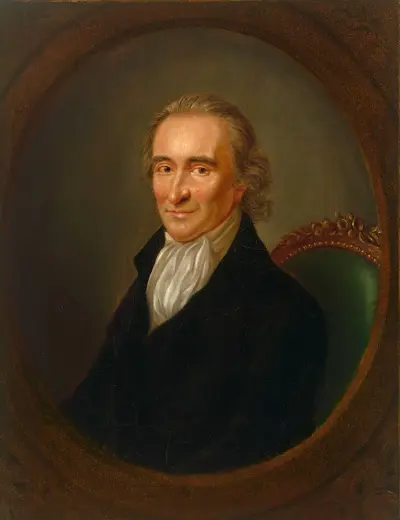
Thomas Paine was an English-born American political activist, philosopher, political theorist, and revolutionary. He authored Common Sense (1776) and The American Crisis (1776–1783), the two most influential pamphlets at the start of the American Revolution, and helped inspire the patriots in 1776 to declare independence from Great Britain. His ideas reflected Enlightenment-era ideals of transnational human rights. Historian Saul K. Padover described him as "a corsetmaker by trade, a journalist by profession, and a propagandist by inclination".
