Zine El Abidine Ben Ali Quotes
Write on any subject you choose. There are no taboos except what is prohibited by law and press ethics.
On the relaxation of the stringent censorship of the press in Tunisia:
Zine El Abidine Ben Ali, Tunisian President, Statement to journalists, May 2001, Quoted in “How Arabs Fight Islamism,” The National Interest, Fall 2003
Sourced by: Eigen's Political and Historical Quotations

Arguing agaist libel and sedition prosecutions:

Note how the second paragraph nullifies the first of the government declares an emergency. This is a trick that is very common in constitutions.


In September of 2005 a Danish Newspaper published some political cartoons showing the hypocrisy of some Muslims who use Islam to justify murder of innocents and terrorism. Months later, in January of 2006 many in the Middle East protested vehemently and Muslim fatal riots broke out because the Prophet Muhammad's visage was depicted against Islamic tradition. Many Muslim nations started a boycott against Denmark. Many Muslim leaders claimed that insulting religion was an “abuse” of freedom of speech including those from nations which regularly publish material that is virulent against Christians and Jews.
In September of 2005 a Danish Newspaper published some political cartoons showing the hypocrisy of some Muslims who use Islam to justify murder of innocents and terrorism. Months later, in January of 2006 many in the Middle East protested vehemently and Muslim fatal riots broke out because the Prophet Muhammad's visage was depicted against Islamic tradition. Many Muslim nations started a boycott against Denmark. Many Muslim leaders claimed that insulting religion was an “abuse” of freedom of speech including those from nations which regularly publish material that is virulent against Christians and Jews.


Two decades later Jefferson, after his Presidency, had developed a different attitude towards the press. See {585116}.
The statement was in protest to the Spanish arrest of a Syrian born journalist, Taysir Alluni, who had been accused of supporting Al-Quaeda cells in Spain by moving money to the cells. Alluni was well connected with Al-Quaeda as he had reported on them for some time and had personally interviewed Osama Bin Laden. Many believe that the cash was a cultural misinterpretation of the Muslim custom of sending cash as a wedding present which the Spanish authorities may have misinterpreted as financing of terrorism. Many believe that he is the victim of Anti-Islamic bias. While many legitimate news organizations are are troubled by this case, the Syrian protest is particularly ironic. In Syria there is not freedom of the press and any reporter can go to jail for offenses from insulting Islam to disparaging the Syrian government and its officials. There is no such thing as freedom of expression in Syria and there has not been since the Baathists gained control of the government.

In September of 2005 a Danish Newspaper published some political cartoons showing the hypocrisy of some Muslims who use Islam to justify murder of innocents and terrorism. Months later, in January of 2006 many in the Middle East protested vehemently and Muslim riots broke out because the Prophet Muhammad's visage was depicted against Islamic tradition. Many Muslim nations started a boycott against Denmark. Many Muslim leaders claimed that insulting religion was an “abuse” of freedom of speech including those from nations which regularly publish material that is virulent against Christians and Jews. Islamic country newspapers however, when it comes to what is perceived as material insulting to Islam, as typified by this editorial, feel that their religion should never be insulted despite the fact that Saudi Arabian media constantly insult Christianity and Judaism. Their justification of this gross double standard is that Islam is the “true” religion.
In September of 2005 a Danish Newspaper published some political cartoons showing the hypocrisy of some Muslims who use Islam to justify murder of innocents and terrorism. Months later, in January of 2006 many in the Middle East protested vehemently and Muslim riots broke out because the Prophet Muhammad's visage was depicted against Islamic tradition. Many Muslim nations started a boycott against Denmark. Many Muslim leaders claimed that insulting religion was an “abuse” of freedom of speech including those from nations which regularly publish material that is virulent against Christians and Jews. Westerners came to the support of Denmark. The United States which usually supports freedom of the press made this veiled criticism of the Danish Newspaper.


Chairman of the Board of The Washington Post. The Attorney General had attempted to suppress information linking him to the Watergate conspiracy by threatening Washington Post staff. The story was run, and Mr. Mitchell was later convicted for his crimes in connection with Watergate.


The libel and slander laws in England were then, and are today, dramatically different from those of the United States in two fundamental ways: In America truth is an absolute defense; in England you can’t say true things about people which are personally libelous. Second, in America politicians and public figures are not entitled to a verdict even if the statements are inadvertently or possibly false. Without the Constitutional protections of freedom of speech and freedom of the press, the reputations of people including public figures are given much more weight in England than in America.


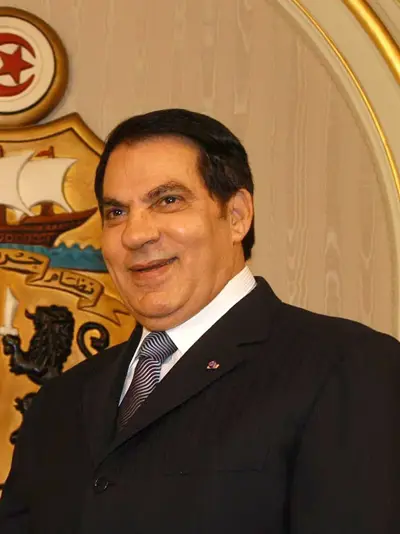
Zine El Abidine Ben Ali, commonly known as Ben Ali (Arabic: بن علي) or Ezzine (Arabic: الزين), was a Tunisian politician who was the second President of Tunisia from 1987 until his fall in 2011 after the revolution of Tunisia . Ben Ali was appointed Prime Minister in October 1987. He assumed the Presidency on 7 November 1987 in a bloodless coup d'état that ousted President Habib Bourguiba by declaring him incompetent. Ben Ali was subsequently reelected with enormous majorities, each time exceeding 90% of the vote; his final re-election coming on 25 October 2009. Ben Ali was the penultimate surviving leader deposed in the Arab Spring who was survived by Egypt's Hosni Mubarak, the latter dying in February 2020.
