Zadie Smith Quotes
Work on a computer that is disconnected from the internet.
Smith, Zadie. "Zadie Smith's 10 Rules of Writing." The Guardian, 20 Feb. 2010.


Many computer experts and security operatives view this kind of advice and strategy as counter-productive as there are some computer security extremists who so harden computer systems and networks that they function poorly and cause really harmful operational problems. The classic case was the FBI agent in Minnesota who before 9-11 had information that Muslims foreigners were taking flying lessons. She wanted to get the information to the national security FBI people, but she was not allowed to send the information by e-mail. Instead she had to use a "secure" system that was much slower and could not be viewed by the people who might have been able to connect the dots and do something about it. The FBI has now a better balance between functionality and security, but it is a good example of how "security fanaticism" can make us less safe.


A few weeks before, the computers of the Democratic National Committee were hacked and thousands of private and confidential e-mails were made public. The security experts claimed that the hackers came from Russia.


At the time this quotation was created, the Chinese hacking had done no harm in the sense that they did not destroy the data in any of our computers or render some computers non-operational. We actually had done that and more – using hacking to affect destroy part of an Iranian nuclear fuel processing facility, but we had never done that to China, nor had China to us. A difference that outraged some Americans is that they viewed it as “fair game” to do espionage on military and political secrets. The Chinese however, in addition to that, did much industrial spying on American commercial innovations and manufacturing techniques. The French and the South Koreans, however, had been doing this for years, and American politicians were careful not to make a public issue about it and try to minimize it with diplomacy. However, all this makes a solution hard to come by as Liebenthal explained in his quotation.
When discussing and planning redistricting What makes this quotation so noteworthy is the fact that to the expert at redistricting, security is so important and E-mail an anathema. The reason is that most redistricting by a majority in a state legislature has little to do with fairness and protecting the meaning of peoples’ votes. It is very often motivated by something that is illegal (eg diluting Black’s voting impact) or untoward, embarrassing and scandalous (eg getting rid of a Congressman the party leaders do not care for—not being ideological enough. Very often, courts or the Justice Department overturn redistricting schemes or the media embarrasses the party who controlled the redistricting. In almost all these cases, the “smoking gun” is the statements or writings of the redistricting leaders. (For an example, see {634844} .)Therefore some redistrictors behave in methods similar to the Mafia, foreign spies, or an illegal monopoly conspiracy.

Many people not only disagreed with him but thought is analogy was also wrong. Most of the nations in the world do not have a navy. The few that do, have never claimed that the navy was deployed for civilian purposes. They did so to protect their merchant ships, prevent blockades and to project power—all military activities. Critics observe that few nations would risk a situation where their enemies might cyberattack them and they would have no defenses and could not counterattack. So other nations will respond to large cyberdefenses deployed by some countries with an “arms race” of cyberdefense. The reason the United States added 4000 personnel to Cyber Command was because China and Russia had deployed cyberdefense capability. Also cyberdefense capability produces cyberattack capability. These critics argue that cyberspace is already militarized.


The law enforcement and the intelligence agencies have been claiming for a number of years that etrong encryption (encryption which no one can crack with existing technology) if used by the general public would really hinder law enforcement and espionage efforts. The Federal government actually obtained a court order prohibiting the inventor of the stong encryption frm sharing the equations and techniques with anyone--as blatant an infringement to the right of free speech as there was been. The order was ignored and although the government tried to intimidate the developer by threatening him with prison. He refused to comply and the government finally dropeed the case, as the courts would almost certainly find such a jailing unconstitutional. However, although they tell the courts that there is a clear and present danger if terrorists use encryption, no one had, up to that time, found a single case where being able to decypher the encryption would have prevented an attack.


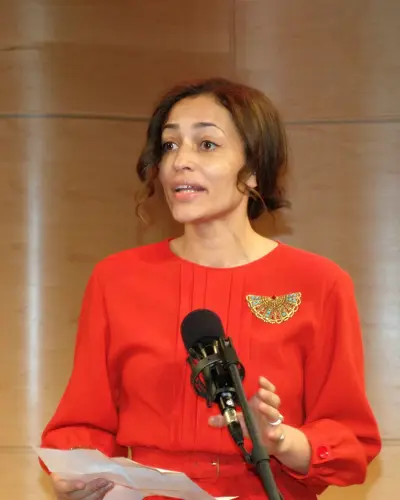
Zadie Adeline Smith FRSL is an English novelist, essayist, and short-story writer. Her debut novel, White Teeth (2000), immediately became a best-seller and won a number of awards. She has been a tenured professor in the Creative Writing faculty of New York University since September 2010.
