Buddha Quotes
Without approval and without scorn, but carefully studying the sentences word by word, one should trace them in the Discourses and verify them by the Discipline. If they are neither traceable in the Discourses nor verifiable by the Discipline, one must conclude thus: 'Certainly, this is not the Blessed One's utterance; this has been misunderstood by that bhikkhu - or by that community, or by those elders, or by that elder.' In that way, bhikkhus, you should reject it.
Buddha. The Long Discourses of the Buddha: A Translation of the Digha Nikaya. Translated by Maurice Walshe, Wisdom Publications, 1995, p. 255.


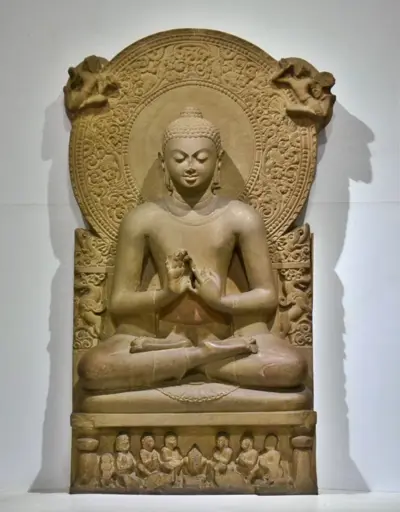
The Buddha (also known as Siddhattha Gotama or Siddhārtha Gautama or Buddha Shakyamuni) was a philosopher, mendicant, meditator, spiritual teacher, and religious leader who lived in what is now Nepal and India (c. 5th to 4th century BCE). He is revered as the founder of the world religion of Buddhism, and recognized by most Buddhist schools as the Enlightened One who is believed to have transcended Karma and escaped the cycle of birth and rebirth. He taught for around 45 years and built a large following, both monastic and lay. His teaching is based on his insight into duḥkha (typically translated as "suffering") and the end of dukkha—the state called Nibbāna or Nirvana.
