William E. Borah Quotes
Without an unfettered press, without liberty of speech, all of the outward forms and structures of free institutions are a sham, a pretense - the sheerest mockery. If the press is not free; if speech is not independent and untrammeled; if the mind is shackled or made impotent through fear, it makes no difference under what form of government you live, you are a subject and not a citizen.
Borah, William E. "Speech on the Espionage Bill." Congressional Record, 65th Congress, 1st Session, vol. 55, Government Printing Office, 1917, p. 777.


Referring to the Erdogan government of Turkey. That country elected Erdogan who then turned his back on the Ataturk inspired democracy and instituted many non-democratic policies and practices including jailing civil servants, teachers and journalists who publicly criticize the president or the government.


The poem was in a dialect. “Gret” was “great” and “pint” was “point”.


He was subpoenaed by the House Un-American Activities Committee where he was accused of being a Communist which he eloquently denied starting with this statement. He died of a heart attack 3 days later. However, most historians agree that White passed classified information to the Russians. He was accused of being a Communist, but there was never any evidence of that. Some people believe that he was a spy for the Russians and committed espionage, but others disagree observing that White was very much his own man and felt that much information that was classified never should have been. White substituted his own judgment, it is believed, about what could be given to the Russians for the security system. He was an admirer of what Russian socialism had accomplished economically, educationally and medically since the 1917 revolution deposing the Czar. Russia had been a valuable military ally, which had taken the brunt of both military and civilian casualties in WWII. White’s economics were certainly not Marxist but very much Keynesian.


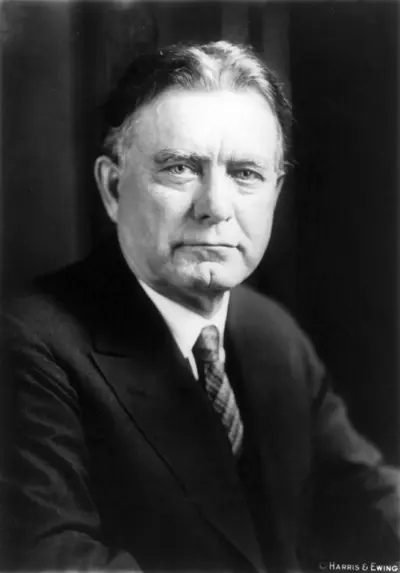
William Edgar Borah was an outspoken Republican United States Senator, one of the best-known figures in Idaho's history. A progressive who served from 1907 until his death in 1940, Borah is often considered an isolationist, because he led the Irreconcilables, senators who would not accept the Treaty of Versailles, Senate ratification of which would have made the U.S. part of the League of Nations.
