Martin Van Buren Quotes
With respect to the northeastern boundary of the United States, no official correspondence between this Government and that of Great Britain has passed since that communicated to Congress toward the close of their last session.
Van Buren, Martin. "Second Annual Message." The American Presidency Project, edited by Gerhard Peters and John T. Woolley, 3 Dec. 1838.

Because the early nation's government was still in a state of becoming, foreign powers were hesitant to do business and conclude treaties with the newly-formed United States of America:


Kennan was talking about the Russians, but the same principle seems to hold with any autocratic government and in some cases even democracies. However, the tradition of secret diplomacy with no transparency is established even in many democracies. Great Britain and France, for example conduct most of their diplomacy in secret as do less democratic governments and tyrannies. They expect us to keep negotiations confidential, which causes American diplomats to be torn between the American view of transparency and the tradition of confidentiality.


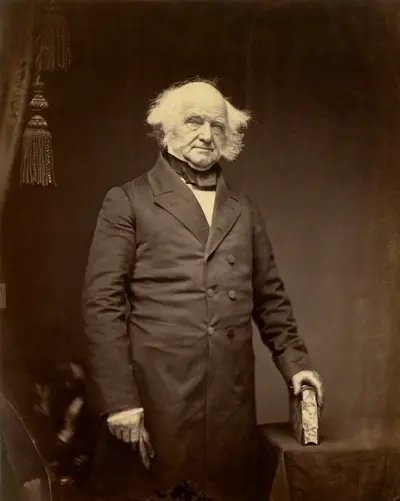
Martin Van Buren was an American lawyer and statesman who served as the eighth president of the United States from 1837 to 1841. A founder of the Democratic Party, he had previously served as the ninth governor of New York, the tenth United States secretary of state, and the seventh vice president of the United States. He won the 1836 presidential election with the endorsement of popular outgoing President Andrew Jackson and the organizational strength of the Democratic Party. He lost his 1840 reelection bid to the Whig nominee, William Henry Harrison, thanks in part to the poor economic conditions surrounding the Panic of 1837. Later in his life, Van Buren emerged as an elder statesman and an important anti-slavery leader who led the Free Soil Party ticket in the 1848 presidential election.
